

Art, Memory, and Bitter Christmas
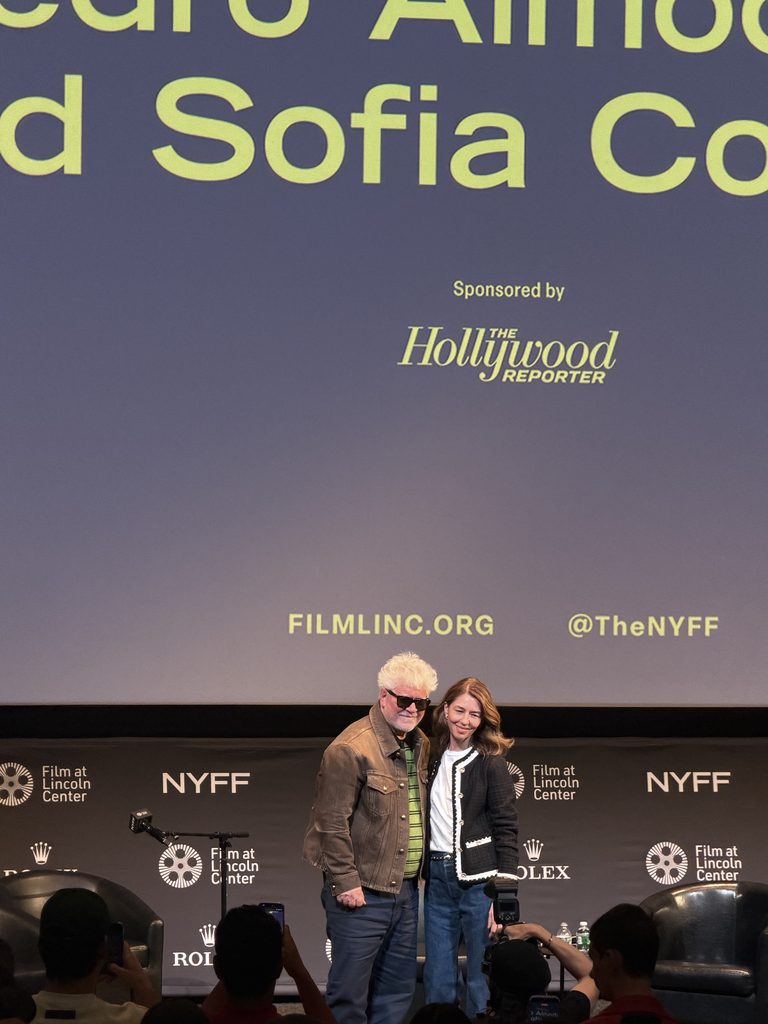
At the New York Film Festival screening of Bitter Christmas, I found myself responding to Pedro Almodóvar through several layers of recognition: the filmmaker whose work has accompanied me for decades, the visual storyteller whose eye continues to move me, and the man whose creative world intersects with my memories of Madrid.
My connection to his cinema has always been visual. With my background in art and design, I pay attention to the paintings, furniture, colors, and relationships between objects. In Pedro’s films, these choices have emotional weight. A room tells us something about the person who inhabits it before that person speaks. A painting can introduce another story within the story we are watching.
Sigfrido Martín Begué is an important part of that connection. Having known Sigfrido, I bring something personal to seeing his work in Pedro’s cinematic world. In my earlier writing about Pain and Glory, I discussed his paintings Las Costureras and Santa Casilda – El Olfato, and the friendship between the artist and the filmmaker. Their presence gave those interiors a particular resonance for me. There were people and relationships behind the images.
Sigfrido’s combination of classical references, theatricality, invention, and irony offers a useful way of looking at Pedro’s films. Both invite us into carefully constructed worlds where beauty accommodates strangeness. Elegance and absurdity can occupy the same space. The visual pleasure draws us in, then gives us something less comfortable to consider.
That connection continues in Bitter Christmas, which includes Sigfrido’s 1987 screenprint Santa Cecilia in Patricia’s apartment. For me, the inclusion opens a conversation across different moments in Pedro’s work, and between cinema and painting. It also makes me think about how an artist’s presence survives through the choices of others: what they collect, what they display, and what they bring into view again.
This gave particular weight to Pedro’s comment about the selfishness of writers who draw friends and family into their stories. I was moved by his acknowledgment. What happens when someone close to us becomes material? Whose version of a shared experience survives? The writer has the power to arrange, omit, and give the story its ending.
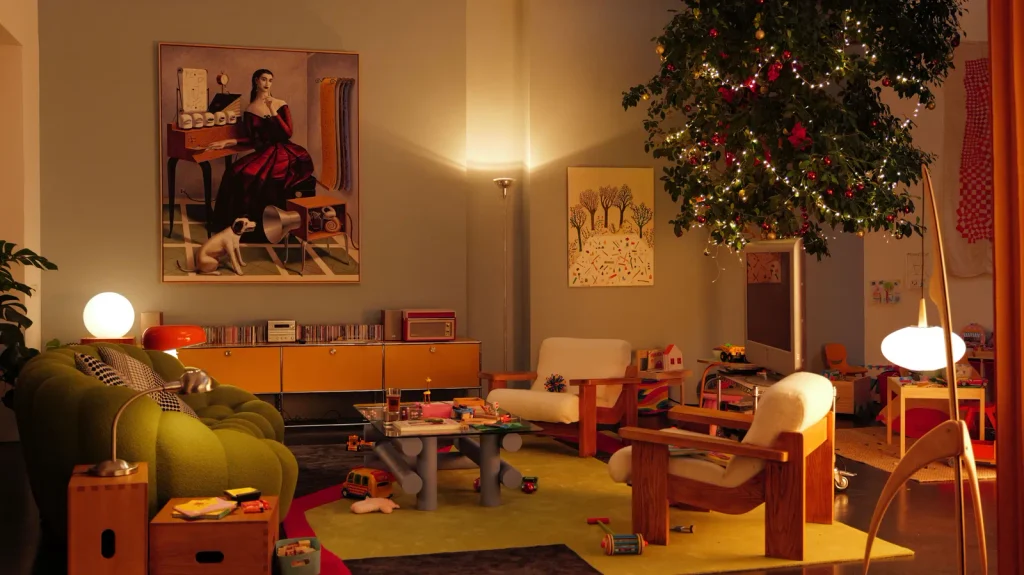
I found myself considering a related question through the art: how do we carry people into our work? A painting on a wall can become a form of remembrance. Its meaning changes when we know something about the person who made it and the person who chose to place it there.
Yet my admiration for the visual world of Bitter Christmas did not entirely resolve my reservations about its storytelling. Some of the material felt repetitive. I recognized emotional concerns Pedro has explored before, but did not always feel that I was discovering something new within them. My eye remained engaged even when my involvement in the narrative weakened.
Perhaps that response reveals my own expectations. I still long for the Pedro drawn to subcultures, unconventional desires, unruly people, and the possibilities of lives lived outside social approval. My years in Madrid are part of that attachment. His earlier films belong to my understanding of a place and a period, as well as to my history as a viewer.
Seeing him in person added another dimension. He looked older than I had expected, and seemed comfortable inhabiting his age. The attentiveness of his partner beside him was touching. It made me conscious of the years through which both an artist and his audience travel.
I want to leave room for the filmmaker he is becoming. At the same time, I miss the surprise I once associated with entering his world. The art still brings me close. Sigfrido’s presence deepens that connection. But I am still chasing that Pedro, hoping his next story will take me somewhere I did not know I wanted to go.
About Sigfrido Martín Begué
Sigfrido Martín Begué (Madrid, April 19, 1959 – December 31, 2010) was a painter, architect, and designer, and one of the defining artists of La Movida Madrileña. He began painting in the late 1970s as part of Los Esquizos, a figurative group that drew on Pop art, cinema, comics, and popular music.
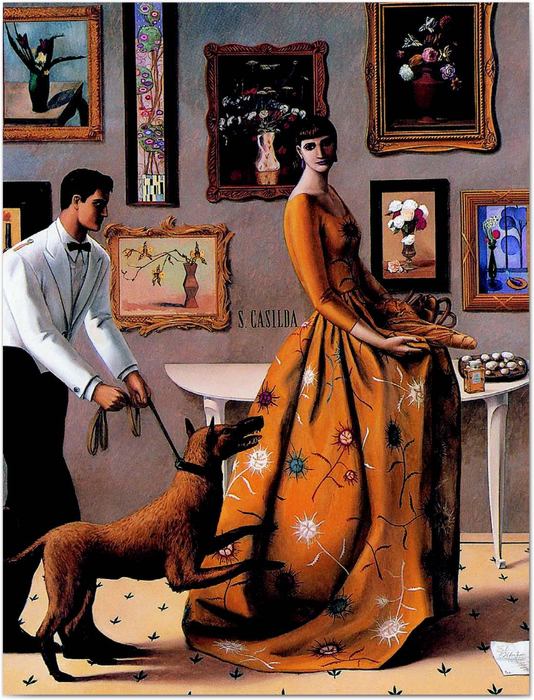
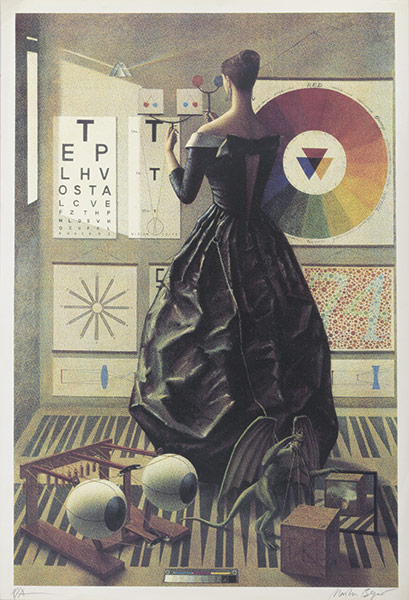

Trained at the Madrid School of Architecture, he brought an architect’s eye to painting: geometric compositions, classical forms, and a fearless use of color. His work draws on Mannerism, mythology, and the Renaissance and Baroque, often staging scenes that are at once elegant and quietly unsettling. He received a fellowship at the Spanish Academy in Rome, where his series Los sentidos (The Senses) was first exhibited, and he also taught and designed for the stage, creating sets and costumes for opera, ballet, and theater.
His saints, from Santa Casilda and Santa Lucía to Santa Cecilia, are among his best-known images. His paintings are held in public collections including the Centro de Arte Dos de Mayo (CA2M), the La Caixa Collection, and the Museo Patio Herreriano in Valladolid.
To explore more of his work, including screenprints of his saints, visit Universo Sigfrido.