In September 2015, the Historical Society presented “reVISION::THINKING BIG, New Projects in Washington DC,” an exhibit focused on five mixed-use projects currently in design in Washington and in the final stages of development review, or under construction.
The projects include The Yards, The Wharf, Burnham Place at Union Station, Capitol Crossing, and the McMillan Sand Filtration site. The exhibit examined the theories and context behind each project’s design as well as the complexity inherent in projects of such vision and scope.
The themes addressed include:
Reconnecting to the water
Building above barriers, and
Re-purposing public works
Organized by AIA|DC, the exhibit was supplemented by material from the Historical Society’s collections to tell the stories of the past while looking towards the city’s future.
In 2015, the Historical Society of Washington, D.C. launched a groundbreaking program called “For the Record: Artfully Historic D.C.” This innovative initiative aimed to capture and preserve scenes of the District’s built environment through various art forms.
Partnering with the DC Preservation League, the National Building Museum, and the Capitol Hill Art League, the Historical Society organized a juried competition of paintings and photography to showcase the changing urban landscape of Washington, D.C. The collaboration with the DC Preservation League led to the creation of a list of the Most Endangered Places in Washington, D.C. These buildings, at risk of being lost or destroyed, inspired local artists who submitted their artworks to the exhibit.
For the Record: Artfully Historic DC
April 22, 2015 – June 19, 2015
In 2015, the Historical Society of Washington, D.C. (HSW) launched “For the Record: Artfully Historic D.C.,” a new program to capture and preserve scenes of the District’s built environment. Along with the DC Preservation League, the National Building Museum, and the Capitol Hill Art League as co-sponsors, the Historical Society produced a juried competition of paintings and photography. Over 100 artists participated, submitting paintings and photographs depicting the city’s dynamic architecture. The top 75 artworks were selected by a panel of nine jurors and displayed at the Historical Society’s headquarters in the Carnegie Library at Mt. Vernon Square. The top five winning entries were added to the Historical Society’s permanent collection, while the remaining works were auctioned to support the organization’s preservation efforts. The success of the inaugural exhibit paved the way for future editions of “For the Record,” each focusing on different aspects of Washington, D.C.’s development.
In subsequent years, the program continued to thrive with exhibits such as “For the Record: Changing DC” and “For the Record: Picturing DC,” which showcased the work of local artists and captured the essence of the city’s neighborhoods in various wards. The Historical Society’s dedication to documenting and celebrating Washington, D.C.’s rich history and architecture through art has not only engaged the community but also raised funds to support the preservation of the city’s heritage for generations to come.
Presented at the George Washington University Museum|The Textile Museum in Foggy Bottom, these exhibits offer a visual journey through Washington, D.C.’s evolving landscape, providing a unique and artistic perspective on the city’s development. “Artistic Reflections of the District” continues to be a testament to the Historical Society’s commitment to preserving and celebrating the vibrant history of Washington, D.C.
In response to the organization’s need to re-engage with the local community while advancing the documentation of current development projects in the city, “For the Record” was created. The program resulted in three consecutive annual exhibits, providing new audiences and fundraising while partnering with other local groups.
For the Record: Changing DC
April 15, 2016 – July 16, 2016
The Historical Society aims to continue the tradition of capturing Washington’s built environment through the arts. For the Record is an annual juried exhibit of artwork capturing Washington’s changing urban landscape. The Historical Society of Washington, D.C., challenges local artists to create 2D artwork depicting Washington’s changing built environment. For the Record provides exposure, recognition, and enduring prestige to local artists and raises funds to support the Historical Society.
For the Record: Picturing DC
November 9, 2017 – March 4, 2018
For the Record: Picturing D.C. is a juried exhibit of 44 original artworks by 25 local artists focused on neighborhoods in each of Washington, D.C.’s eight wards. These two-dimensional artworks, created between 1988 and 2017, offer the artists’ interpretations of Howard Town/Pleasant Plains, Burleith, Palisades, Shepherd Park, Ivy City, Buzzard Point, Kenilworth, or Congress Heights.
Since its founding in 1894, the Historical Society of Washington, D.C., has collected and preserved paintings, illustrations, and photographs depicting the city’s built environment. By encouraging continued artistic documentation of the modern city, For the Record continues this tradition for future generations. The exhibit is presented at the George Washington University Museum|The Textile Museum in Foggy Bottom.
In 2013, the Bailey-Matthews National Shell Museum launched new branding and implemented new digital solutions for membership, marketing, and visitor engagement. The museum implemented the use of new technologies, including social media and group marketing strategies to successfully exceed attendance goals. The results of these new initiatives resulted in increased community participation and better engagement from visitors during their visit to the museum.
The museum became a partner in the Southeastern Reciprocal Museums (SERM) and the North American Reciprocal Museums (NARM). These two programs enhanced marketing and visibility while adding great value to Museum membership.
The Raymond Burr Memorial Exhibit and Henry Domke both enhance the historical and artistic aspects of the museum. John managed and led staff and the board of trustees during several special events. He promoted interest in the museum within its local, national, and international communities.
Mr. Suau implemented mobile museum technology to help sustain visitor engagement using QR codes, audio tours, and mobile web-based games.
Amanda Stirn
As the Senior Assistant Director of the Shell Museum, I was so excited to have John join our team. John was the key person for all the marketing, advertising and public relations for the Bailey Matthews Shell Museum…His experience in Museum art and impact on the observer is amazing. I would recommend him highly to any museum in the process of a realignment with their strategic goals or looking to expand beyond the norm. You will appreciate John’s attention to detail and his wonderful work in bringing together vision and reality. John is a true asset to any team: personable, upbeat, and very artist with a keen eye for all the details.
Amanda Stirn, Business Consultant at Florida SBDC at Florida Gulf Coast University
The art of Sigfrido Martín Begué is surreal and futuristic at the same time, drawing on the painterly techniques of Italy and Spain’s neoclassical masters. His work embraces modern and contemporary themes while deploying deeply rooted Christian symbolism and metaphor.
The style recalls De Chirico and El Greco with a postmodern twist. Sigfrido’s figures are often elongated and stylized, and his palette is bold in places and muted in others. His sense of humor and irony is evident in almost every major work. His portfolio ranges from pencil drawings to large-scale oil paintings executed with the precision of his Spanish predecessors, and his paintings fit into large contemplative themes, from Los Autómatas to Las Máquinas.
In his Santas series, each saint represents one of the five senses, and every dress is inspired by the designs of Cristóbal Balenciaga, who opened his first boutique in San Sebastián, Spain, in 1917.
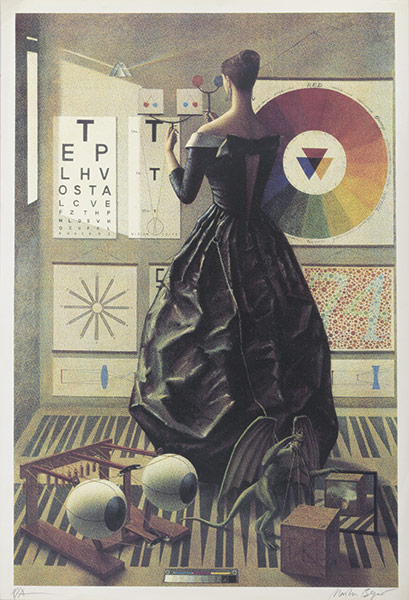
Santa Lucía – La Vista
Sigfrido Martín Begué, 1990 Image courtesy Mar Estrada; photo by Juan Luque
Sigfrido’s Santa Lucía – La Vista is a vibrant painting about vision. The large eyes in the foreground are the clue that this is Santa Lucía. With her back to the viewer, we cannot see her eyes at all. Like the other Santas, she wears a Balenciaga-inspired dress. She is taking a vision test, and on the wall the artist has created a gallery of eye charts and visual examinations. In the foreground, a small demon plays with the kind of visual trickery painters have long used.
About Santa Lucía
Santa Lucía (283–304) was born in Syracuse, Sicily, the daughter of a Roman nobleman who died when she was five. She pledged her virginity to God and gave her riches to the poor, though her widowed mother had already promised her to a wealthy pagan. When he learned that her dowry had been given away, he denounced her to the governor. According to legend, attempts to defile her and burn her at the stake failed, and her eyes were put out before her death. She is the patron saint of the blind and of eyesight.
Santa Cecilia – El Oído
Sigfrido Martín Begué, 1989 Image courtesy Mar Estrada; photo by Juan Luque
Sigfrido’s Santa Cecilia – El Oído is a beautifully composed image about sound. We know this is Santa Cecilia because the artist has seated her at the organ, one of the traditional ways she has been portrayed. Everything in the work asks us to contemplate sound, from the dog, a nod to “Nipper” of the 1898 gramophone advertisements, to the inner workings of the machine. Notice the ear canals inside the gramophone and the five mouths on top of the organ, each forming a vowel. Is Santa Cecilia listening to every sound in the room? Does she hear what the dog hears, or the voices singing as she touches the keys? Like the other saints, she wears a Balenciaga dress.
About Santa Cecilia
Santa Cecilia was a Roman noblewoman who pledged her virginity to God but was married to a man named Valerian. Having “sung in her heart to God” during the wedding, she told him a guardian angel protected her. Valerian asked for proof; after his baptism he saw the angel, and he was later martyred before her. According to legend, she survived an attempt to suffocate her in the baths and lived for three days after a failed beheading, and her body was later found intact. She is the patron saint of music.
As seen in Pain and Glory
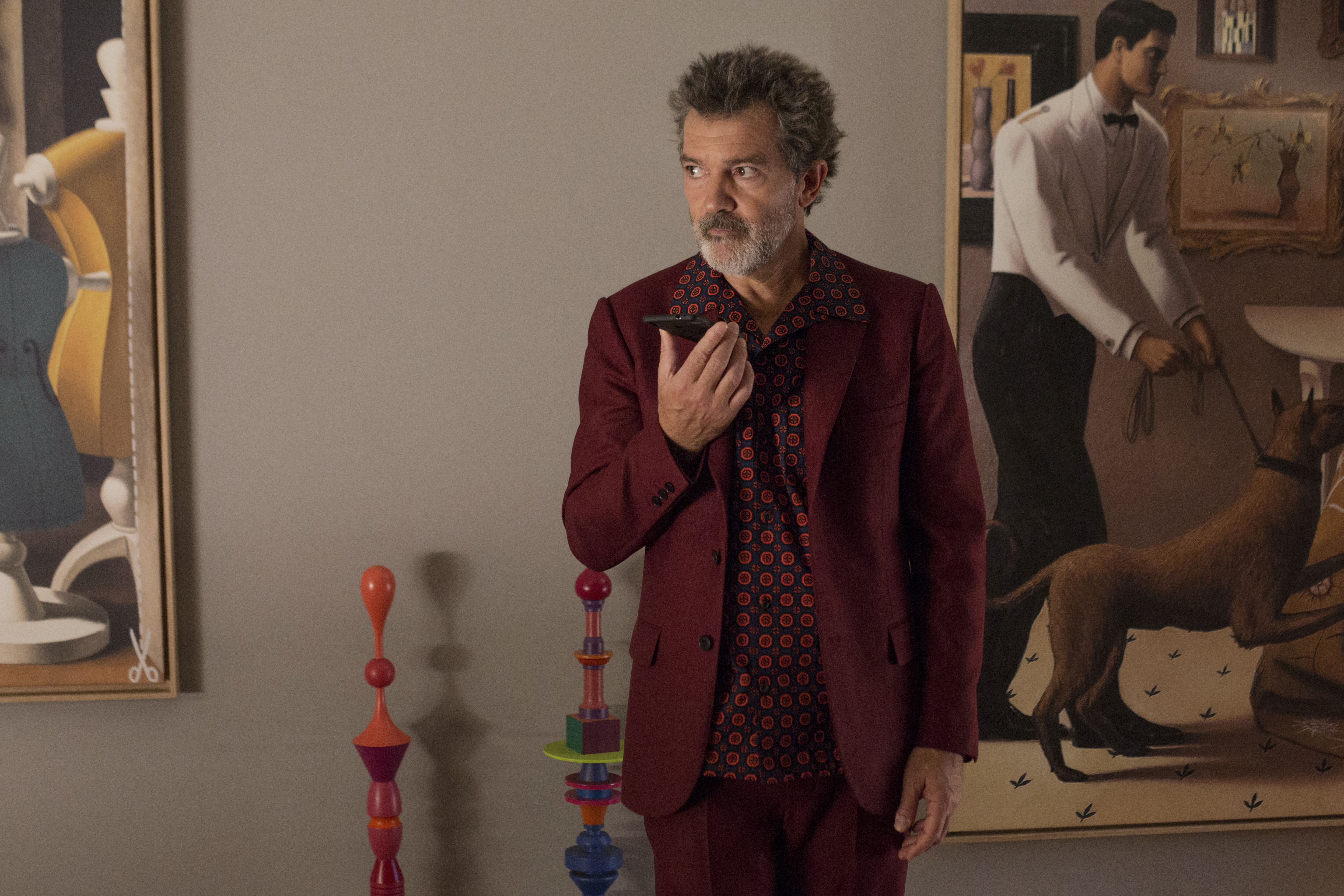
Sigfrido Martín Begué (Madrid, 1959–2010) created two of the most prominent paintings in Pedro Almodóvar’s Pain and Glory: Las Costureras (1996) and Santa Casilda – El Olfato (1986).
Salvador Mallo (Antonio Banderas) between two paintings by Sigfrido Martín Begué in Pain and Glory: Las Costureras (left) and Santa Casilda – El Olfato (right). Image courtesy El Deseo D.A. S.L.U., photo by Manolo Pavón.
The ‘Tesoros del Arte Español’ exhibit, showcased at Expo ’92 in Seville, Spain, mesmerized visitors with a captivating display of Spain’s rich artistic heritage. This article delves into the exhibit’s significance, cultural highlights, and enduring legacy in the world of art and culture.
Highlights of the ‘Tesoros del Arte Español’ Exhibit
Exhibit Catalog
The ‘Tesoros del Arte Español’ exhibit featured a diverse collection of masterpieces by famous Spanish artists such as Goya, Velázquez, El Greco, and Picasso. From sublime paintings to exquisite sculptures, the exhibit offered a comprehensive showcase of Spain’s artistic brilliance through the ages. Visitors to the exhibit were treated to a visual feast of Spain’s cultural heritage, including architectural elements, textiles, ceramics, and more. The exhibit highlighted the rich tapestry of Spain’s artistic traditions and showcased the country’s unique cultural identity through its artistry. The ‘Tesoros del Arte Español’ exhibit provided visitors with an educational and inspiring experience, offering insights into Spain’s artistic legacy and historical significance. Through interactive displays and guided tours, visitors deepened their understanding of Spanish art and history in a visually captivating setting.
The legacy of the ‘Tesoros del Arte Español’ exhibit at Expo ’92 lives on in the hearts and minds of art enthusiasts worldwide. The exhibit celebrated Spain’s artistic heritage and inspired a renewed appreciation for Spanish art and culture, impacting the global cultural landscape.
The ‘Tesoros del Arte Español’ exhibit at Expo ’92 in Seville, Spain, was a captivating journey through Spain’s artistic legacy, showcasing the country’s rich heritage to a global audience. Through its diverse collection of masterpieces and immersive experience, the exhibit continues to be celebrated for its cultural significance and contribution to the art world.
John Suau was the technical curator for two exhibitions in the Spanish Pavilion at Seville’s World’s Fair, EXPO’92. “Treasures of Spanish Art” was a major exhibition about the history of Spanish art that was on display in the pavilion from April through October 1992. John worked on the exhibition loans, specifically those coming from significant institutions in the United States of America like the Metropolitan Museum of Art, the Museum of Modern Art in New York City, and the National Gallery of Art in Washington, D.C. John worked closely with the exhibit curators to ensure the safe and secure transportation of artwork for the exhibit. He worked with exhibition specialists on the installation of the artwork. John also worked with conservators from several countries to ensure the exhibition succeeded with minimal impact on the artwork.
Galician Women at the Window, Bartolomé Esteban Murillo
The 1992 World’s Fair took place from Monday, April 20 to Monday, October 12, 1992 on La Isla de La Cartuja (Cartuja Island), Seville, Spain. The theme for the Expo was “The Age of Discovery”, celebrating the 500th anniversary of Christopher Columbus reaching the Americas after launching from Seville’s port (on the Guadalquivir), and over 100 countries were represented.
Galician Women at the Window, Bartolomé Esteban Murillo, The National Gallery of Art, Washington, D.C.
Treasures of Spanish Art was a major exhibition about the history of Spanish art on display in the Spanish pavilion from April through October of 1992. John worked on the exhibition loans, specifically those coming from major institutions in the United States of America like the Metropolitan Museum of Art and the Museum of Modern Art in New York City and the National Gallery of Art in Washington, D.C.
Passages: New Spanish Art was a large exhibit of Spain’s prominent contemporary artists including Antoni Tàpies i Puig, Eduardo Chillida, Carmen Jiménez, Miquel Barceló, Antonio López García, Cristina Iglesias, and Juan Muñoz, among many others. John worked directly with each artist during the planning and installation of the artworks in the Spanish Pavilion.
John Suau was technical curator for two exhibitions on display in the Spanish Pavilion in Seville’s World’s Fair, EXPO’92 from April through October of 1992. Passages: New Spanish Art was a large exhibit of Spain’s prominent contemporary artists including Antoni Tàpies i Puig, Eduardo Chillida, Carmen Jiménez, Miquel Barceló, Antonio López García, Cristina Iglesias, and Juan Muñoz, among many others. John worked directly with each artist during the planning and installation of the artworks in the Spanish Pavilion.
Sculpture by Juan Muñoz
John worked closely with the exhibit curators to ensure the safe and secure transportation of artwork for the exhibit. He worked with exhibition specialists on the installation of the artwork. John also worked with conservators from several countries to ensure the exhibition was a success with minimal impact on the artwork. John went on to work for Juan Muñoz as his business manager in Madrid, Spain during the artist’s tenure at the American Academy in Rome.
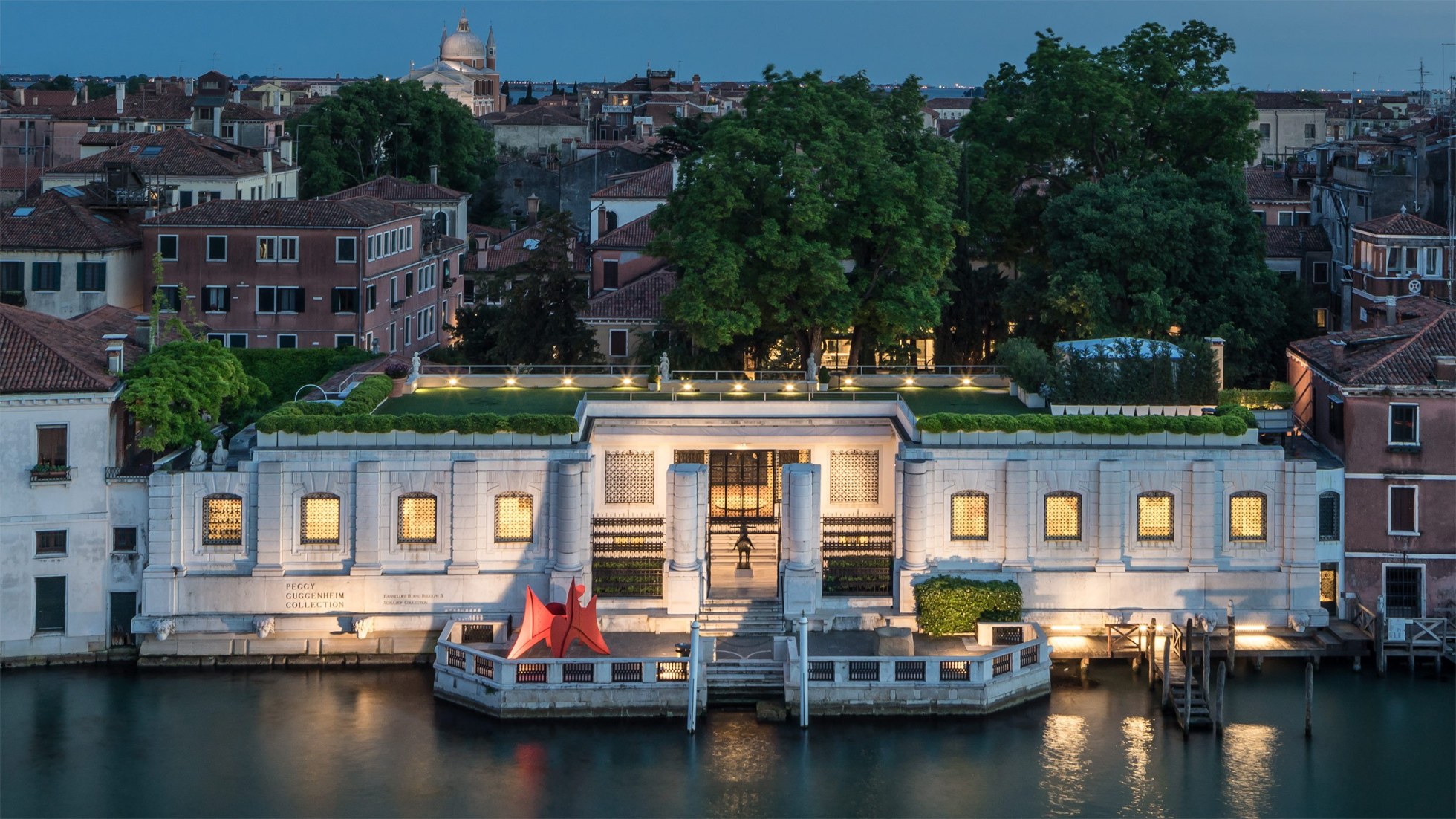
John Suau served as an intern at the Peggy Guggenheim Collection in Venice, Italy in 1988. One of two undergraduate students selected for an internship during the museum’s partial closing to the public during the restoration of the palazzo’s roof.
Working directly with the museum director and chief collection director, Mr. Suau assisted with the removal of all the artworks for the construction work in the building. Mr. Suau also assisted with the reinstallation of the exhibits in one of the world’s premier modern art collections.



 In 2015, the Historical Society of Washington, D.C. (HSW) launched “For the Record: Artfully Historic D.C.,” a new program to capture and preserve scenes of the District’s built environment. Along with the