Category: Gallery

  • DC History Center

    DC History Center

    digital marketing strategist
    John Suau

    Created over five years, the DC History Center, an urban history center in the US, opened on May 11, 2019. The center includes a library and a museum and is operated by the Historical Society of Washington, D.C. Founded in 1898, the society has long struggled to find the “right-size” home to support its mission in Washington.

    The Historical Society closed in 2011 due to a lack of funding and was without a director for three years. After a two-year search, the Historical Society hired John Suau. Under his leadership, a beautiful new destination for DC history was created. The American Architecture Awards recently named Apple’s transformative restoration of the Carnegie Library the best restoration of 2020. With the support of technology, its transition into a 21st-century urban history center is finished.

    Digital Communications

    Rebranding the organization

    Creating a new digital footprint with a cost-efficient blog website enabled easier integration with other digital marketing tools.

    The organization was rebranded as @dchistory to strengthen the brand consistently across Twitter/X, Instagram, and Facebook.

    Exhibits

    Creating new exhibits enlivened community participation and engaged artists and photographers in the Historical Society’s work.

    For the Record is one example. This was a crowd-sourced exhibit program about documenting the built environment of contemporary Washington, D.C. A group of museum curators juried the exhibition. It rapidly grew into one of the local community’s most engaging exhibits. From 2017 through May 2019, the Historical Society vacated the Carnegie Library to restore it.

    During the restoration, community partners played a crucial role. The Newseum, the National Building Museum, and the George Washington University Museum provided program and operation space. This allowed for continued engagement with the local community.

    Public Programs

    Partnerships with community organizations are an important part of the new DC History Center. These partners enhance programs and bring new and diverse audiences to the new DC History Center. In 2014, the society partnered with the Smithsonian National Museum of African American History and Culture (NMAAHC). They hosted the final edition of “Saving Our African American Treasures.”

    The DC History Center produced numerous public programs, including tours, workshops, and speaker series. The annual DC History Conference partnered with the DC Public Library and the George Washington University Gelman Library. It worked with the National Archives. The University of the District of Columbia also collaborated. The Smithsonian National Museum of American History was included as well.

    Community Partnerships

    Community partnerships expanded the organization’s reach by establishing strategic alliances with local organizations. Partnerships include the Capital Pride Alliance and the DC Public Library. Other partners are the DC Preservation League, the George Washington University Museum, the National Archives, and the National Building Museum.

    Collaborative relationships were formed with museum colleagues at the Smithsonian Anacostia Museum. Additionally, we connected with colleagues at Smithsonian Associates. We also reached out to the Smithsonian Latino Center and the Smithsonian National Museum of African American History and Culture.

    The Historical Society developed a long-term strategic partnership with the DC Office of Planning. This partnership helped to develop HistoryQuest DC. It is an interactive map with historical data on approximately 127,000 buildings in Washington, DC.

    The map offers many layers of information for the user. The website provides historical data on individual buildings. It also links to information about properties on the National Register of Historic Places.

    Fundraising and Grants

    A complimentary program, the Visionary Historian Award, was established to create a second fundraising event recognizing local historians.


    Together, the award programs increase the organization’s visibility and elevate the brand across the city. The events raised 10-15% of the organization’s annual budget. Augmented support from DC government agencies like the DC Commission on the Arts and Humanities and HumanitiesDC bolstered public support. Project grants from the Office of Planning also contributed. Overall, public support increased by more than 2300%. 

    Corporate Partnerships

    Apple and the Carnegie Library Restoration

    DC History Center

    This new facility includes three exhibit galleries, a research library, a retail store, offices, and state-of-the-art collection storage facilities. From rebranding to a successful partnership with Apple, the DC History Center is now a 21st-century cultural hub. It welcomes all visitors for free, advancing the mission of the Historical Society.

    selma thomas
    Selma Thomas, Museum Consultant

    John brought both vision and good management to the Historical Society and with his professional background and contacts, turned an archaic institution into a vibrant player in the city’s cultural scene.

  • For the Record

    For the Record

    In 2015, the Historical Society of Washington, D.C. launched a groundbreaking program called “For the Record: Artfully Historic D.C.” This innovative initiative aimed to capture and preserve scenes of the District’s built environment through various art forms.

    Partnering with the DC Preservation League, the National Building Museum, and the Capitol Hill Art League, the Historical Society organized a juried competition of paintings and photography to showcase the changing urban landscape of Washington, D.C. The collaboration with the DC Preservation League led to the creation of a list of the Most Endangered Places in Washington, D.C. These buildings, at risk of being lost or destroyed, inspired local artists who submitted their artworks to the exhibit.

    For the Record: Artfully Historic DC

    April 22, 2015 – June 19, 2015

    In 2015, the Historical Society of Washington, D.C. (HSW) launched “For the Record: Artfully Historic D.C.,” a new program to capture and preserve scenes of the District’s built environment. Along with the DC Preservation League, the National Building Museum, and the Capitol Hill Art League as co-sponsors, the Historical Society produced a juried competition of paintings and photography. Over 100 artists participated, submitting paintings and photographs depicting the city’s dynamic architecture. The top 75 artworks were selected by a panel of nine jurors and displayed at the Historical Society’s headquarters in the Carnegie Library at Mt. Vernon Square. The top five winning entries were added to the Historical Society’s permanent collection, while the remaining works were auctioned to support the organization’s preservation efforts. The success of the inaugural exhibit paved the way for future editions of “For the Record,” each focusing on different aspects of Washington, D.C.’s development.

    In subsequent years, the program continued to thrive with exhibits such as “For the Record: Changing DC” and “For the Record: Picturing DC,” which showcased the work of local artists and captured the essence of the city’s neighborhoods in various wards. The Historical Society’s dedication to documenting and celebrating Washington, D.C.’s rich history and architecture through art has not only engaged the community but also raised funds to support the preservation of the city’s heritage for generations to come.

    Presented at the George Washington University Museum|The Textile Museum in Foggy Bottom, these exhibits offer a visual journey through Washington, D.C.’s evolving landscape, providing a unique and artistic perspective on the city’s development. “Artistic Reflections of the District” continues to be a testament to the Historical Society’s commitment to preserving and celebrating the vibrant history of Washington, D.C.

    In response to the organization’s need to re-engage with the local community while advancing the documentation of current development projects in the city, “For the Record” was created. The program resulted in three consecutive annual exhibits, providing new audiences and fundraising while partnering with other local groups.

    For the Record: Changing DC

    April 15, 2016 – July 16, 2016

    The Historical Society aims to continue the tradition of capturing Washington’s built environment through the arts. For the Record is an annual juried exhibit of artwork capturing Washington’s changing urban landscape. The Historical Society of Washington, D.C., challenges local artists to create 2D artwork depicting Washington’s changing built environment. For the Record provides exposure, recognition, and enduring prestige to local artists and raises funds to support the Historical Society.


    For the Record: Picturing DC

    November 9, 2017 – March 4, 2018

    For the Record: Picturing D.C. is a juried exhibit of 44 original artworks by 25 local artists focused on neighborhoods in each of Washington, D.C.’s eight wards. These two-dimensional artworks, created between 1988 and 2017, offer the artists’ interpretations of Howard Town/Pleasant Plains, Burleith, Palisades, Shepherd Park, Ivy City, Buzzard Point, Kenilworth, or Congress Heights.

    Since its founding in 1894, the Historical Society of Washington, D.C., has collected and preserved paintings, illustrations, and photographs depicting the city’s built environment. By encouraging continued artistic documentation of the modern city, For the Record continues this tradition for future generations. The exhibit is presented at the George Washington University Museum|The Textile Museum in Foggy Bottom.

  • Santa Lucía ~ Patron Saint of Vision

    Santa Lucía ~ Patron Saint of Vision

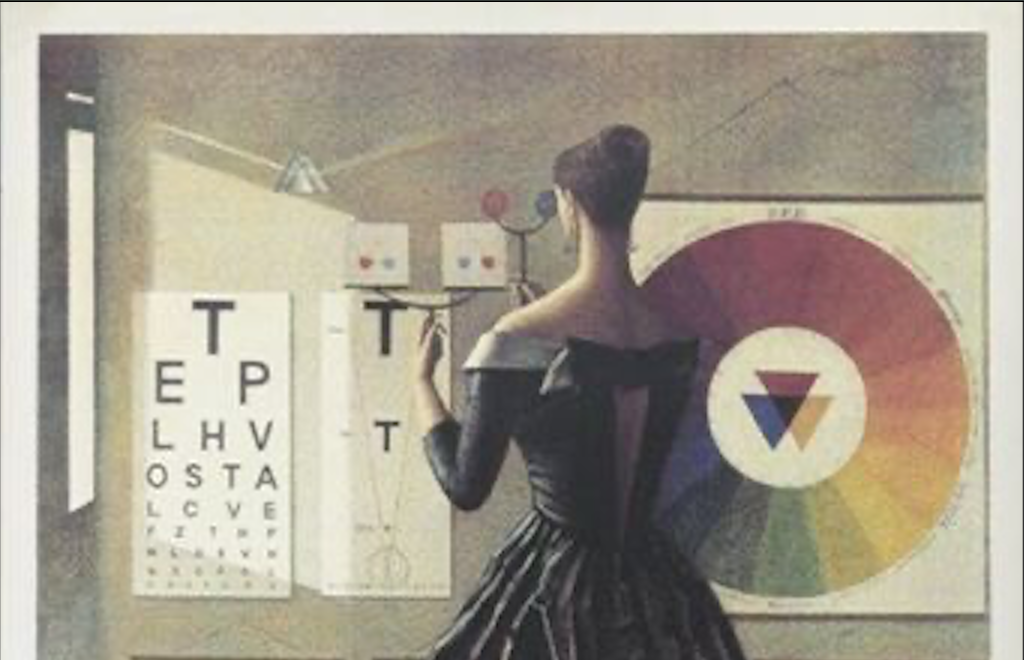
    In his painting Santa Lucía – La Vista, Spanish artist Sigfrido Martín Begué pays tribute to the patron saint of vision.

    Santa Lucía – La Vista, Sigfrido Martín Begué (1990)

    santa lucía vista saint lucia vision
    Santa Lucía – La Vista

    Sigfrido’s Santa Lucía – La Vista is a vibrant painting about vision. The large eyes in the foreground are a big clue that this is Santa Lucía. With her back facing the viewer, we cannot see her eyes at all. Like the other Santas, she is wearing a Balenciaga-inspired dress. She is taking a vision test. On the wall, the artist created a gallery of paintings, including all kinds of visual tests and examinations. Finally, one sees a small demon in the foreground with visual trickery often used by painters.

    About Santa Lucía

    Santa Lucía (283-304) originated in Syracuse, Italy. She was the daughter of a Roman nobleman who died when she was only five years old. Santa Lucía pledged her virginity to God and gave her riches to the poor. Unfortunately, her widowed mother had already promised her to a wealthy pagan. When her betrothed learned of the disbursement of her dowry, he denounced her to the governor. As legend has it, they attempted to defile and burn her at the stake, but she survived. She died after gouging out her eyes. Miraculously, claims that her eyes were intact when unearthed in the 16th century still prevail.

    [maxbutton name=”STA LUCIA”]

    The Art of Martín Begué

    sigfrido martín begué almodóvar spanish painting
    Sigfrido Martín Begue, c. 1989 (Photo courtesy Mar Estrada)

    Sigfrido Martín Begué’s art is surreal and futuristic at the same time, drawing upon painterly techniques of Italy and Spain’s neoclassical painters. His work embraces modern and contemporary societal themes while deploying deeply-rooted Christian symbolism and metaphors. The artwork style recalls De Chirico and El Greco with a post-modern twist. Sigfrido’s figures are often elongated and stylized, and the color palette is bold in places and muted in others. His sense of humor and irony is evident in almost every major work.

    Sigfrigo’s portfolio included his pencil drawings to large-scale oil paintings executed with the precision of his Spanish predecessors. His paintings fit into large contemplative themes, from Los Automátas to Las Máquinas. All of the dresses depicted in the series were inspired by the fashion designs of Cristóbal Balenciaga, who opened his first clothing boutique in 1917 in San Sebastián, Spain.

    Artist Series Available for Collectors

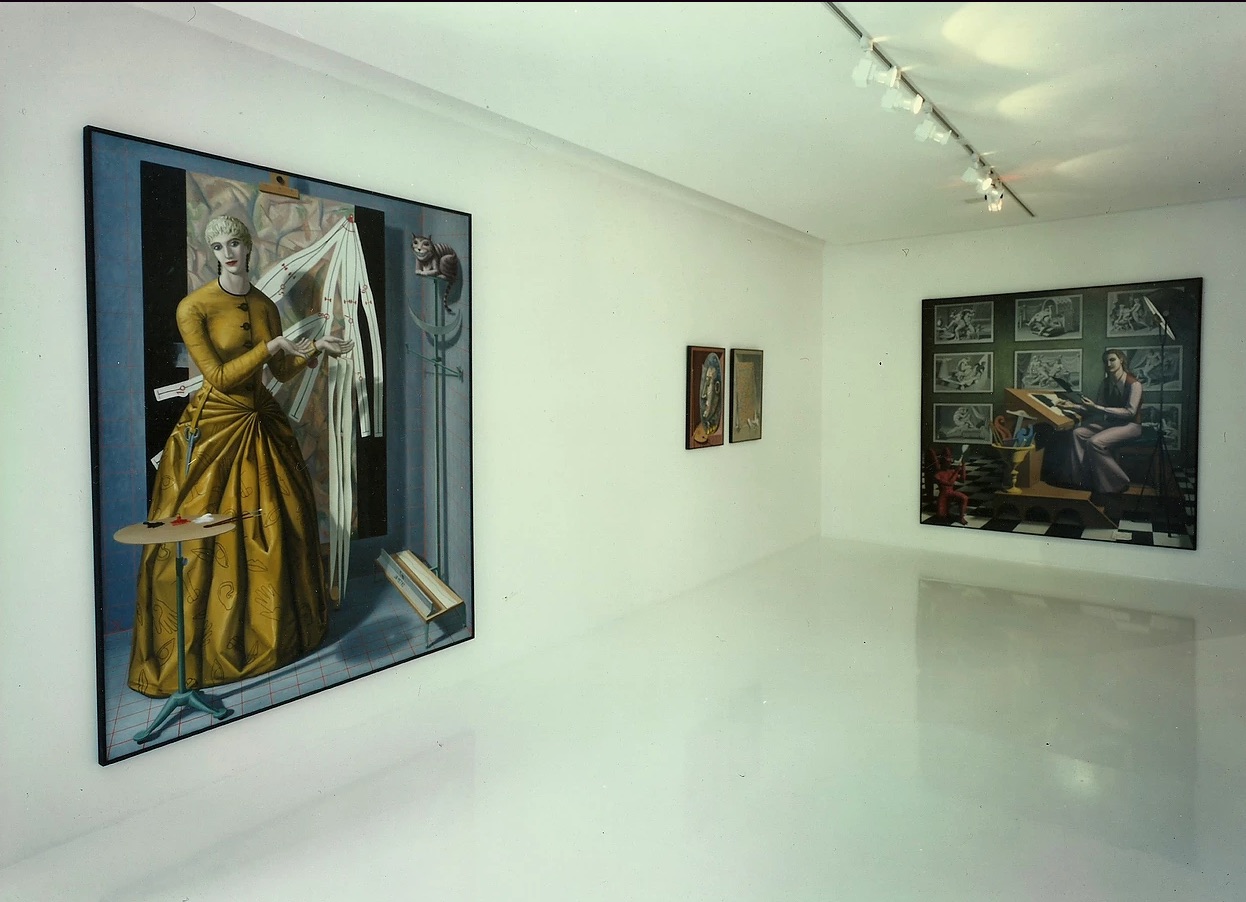
    Santa Lucía – La Vista (1989) was one of a series of five paintings about the senses in the exhibit Máquinas. Produced by Galería Mar Estrada, the exhibition was a solo show of Sigfrido Martín Begué’s most grandiose paintings. Máquinas was a tour-de-force display of the artist’s prolific technique. His images demonstrate fluency in history and in-depth knowledge of saints. Evident is a passion for fashion and a fascination with technology. He loved architecture, composition, and design, which are second only to his command of artistic symbolism.

    To celebrate the 30th anniversary of the exhibit Máquinas, a few signed and numbered silk-screens of Santa Lucía – La Vista are available for purchase.

    [auction-nudge tool=”listings”]

  • Santa Cecilia ~ Patron Saint of Music

    Santa Cecilia ~ Patron Saint of Music

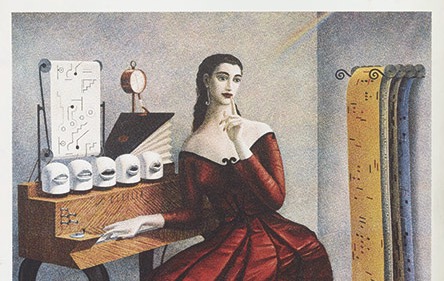
    In his painting Santa Cecilia – El Oído, Spanish artist Sigfrido Martín Begué pays tribute to the patron saint of music.

    santa cecilia patron saint of music Santa Cecilia – El Oído, Sigfrido Martín Begué (Image courtesy Mar Estrada)

    We know this is Santa Cecilia as the artist has her seated at the organ, an artistically accurate way of portraying her. Everything about this work tells us we are contemplating sound. The dog is an apparent reference to the 1898 image of “Nipper” from the Victrola gramophone ads. Notice the ear canals inside the gramophone and the five mouths articulating the vowels. Sigfrido’s use of imagery is rich in detail.

    Santa Cecilia is considering all the sounds in the room. Is she focused on the same sound the dog hears? Or is it the sound from the singing mouths when she touches the keyboard? Like the saints in the other paintings from this series, she wears a Balenciaga inspired dress.

    About Santa Cecilia

    Santa Cecilia (died c. 176 AD) originated in Rome, Italy. She was the daughter of the Roman nobility. She pledged her virginity to God. Eventually, Cecilia wed a man named Valerian out of family obligation. Having “sung in her heart to God” before her wedding, Cecilia explained to her husband that her guardian angel would harm him for defiling her virginity. Her husband asked for proof. After his baptism, he too saw the angel. He became a martyr before Santa Cecilia met her demise. After an attempt to suffocate her in the baths, someone tried to behead her unsuccessfully. She survived the severe wounds to her neck for three days. As legend has it, her body was later uncovered entirely intact. She is the patron saint of music.

    [maxbutton id=”1″ ]

    The Art of Sigfrido Martín Begué

    sigfrido martín begué almodóvar spanish painting Sigfrido Martín Begue, c. 1989 (Photo courtesy Mar Estrada)

    Sigfrido Martín Begué’s art is surreal and futuristic at the same time, drawing upon painterly techniques of Italy and Spain’s neoclassical painters. Sigfrido Martín Begué’s art is surreal and futuristic at the same time, drawing upon painterly techniques of Italy and Spain’s neoclassical painters. His work embraces modern and contemporary societal themes while deploying deeply-rooted Christian symbolism and metaphors. The artwork style recalls De Chirico and El Greco with a post-modern twist. Sigfrido’s figures are often elongated and stylized, and the color palette is bold in places and muted in others. His sense of humor and irony is evident in almost every major work.

    Sigfrigo’s portfolio included his pencil drawings to large-scale oil paintings executed with the precision of his Spanish predecessors. His paintings fit into big contemplative themes, from Los Automátas to Las Máquinas. All of the dresses depicted in the series were inspired by the fashion designs of Cristóbal Balenciaga, who opened his first clothing boutique in 1917 in San Sebastián, Spain.

    Artist Series Available for Collectors

    Santa Cecilia – Begué’s (1989) was one of a series of five paintings about the senses in the exhibit Máquinas. Produced by Galería Mar Estrada, the exhibition was a solo show of Sigfrido Martín Begué’s most grandiose paintings. Máquinas was a tour-de-force display of the artist’s prolific technique. His images demonstrate fluency in history and in-depth knowledge of saints. Evident is a passion for fashion and a fascination with technology. He loved architecture, composition, and design, which are second only to his command of artistic symbolism.

    To celebrate the 30th anniversary of the exhibit Máquinas, a few signed and numbered silk-screens of Santa Cecilia – El Oído are available for purchase.

    [auction-nudge tool=”listings”]

  • The ‘Tesoros del Arte Español’ Exhibit at Expo ’92

    The ‘Tesoros del Arte Español’ Exhibit at Expo ’92

    The ‘Tesoros del Arte Español’ exhibit, showcased at Expo ’92 in Seville, Spain, mesmerized visitors with a captivating display of Spain’s rich artistic heritage. This article delves into the exhibit’s significance, cultural highlights, and enduring legacy in the world of art and culture.

    Highlights of the ‘Tesoros del Arte Español’ Exhibit

    Exhibit Catalog

    The ‘Tesoros del Arte Español’ exhibit featured a diverse collection of masterpieces by famous Spanish artists such as Goya, Velázquez, El Greco, and Picasso. From sublime paintings to exquisite sculptures, the exhibit offered a comprehensive showcase of Spain’s artistic brilliance through the ages. Visitors to the exhibit were treated to a visual feast of Spain’s cultural heritage, including architectural elements, textiles, ceramics, and more. The exhibit highlighted the rich tapestry of Spain’s artistic traditions and showcased the country’s unique cultural identity through its artistry. The ‘Tesoros del Arte Español’ exhibit provided visitors with an educational and inspiring experience, offering insights into Spain’s artistic legacy and historical significance. Through interactive displays and guided tours, visitors deepened their understanding of Spanish art and history in a visually captivating setting.

    The legacy of the ‘Tesoros del Arte Español’ exhibit at Expo ’92 lives on in the hearts and minds of art enthusiasts worldwide. The exhibit celebrated Spain’s artistic heritage and inspired a renewed appreciation for Spanish art and culture, impacting the global cultural landscape.

    The ‘Tesoros del Arte Español’ exhibit at Expo ’92 in Seville, Spain, was a captivating journey through Spain’s artistic legacy, showcasing the country’s rich heritage to a global audience. Through its diverse collection of masterpieces and immersive experience, the exhibit continues to be celebrated for its cultural significance and contribution to the art world.

    John Suau was the technical curator for two exhibitions in the Spanish Pavilion at Seville’s World’s Fair, EXPO’92. “Treasures of Spanish Art” was a major exhibition about the history of Spanish art that was on display in the pavilion from April through October 1992. John worked on the exhibition loans, specifically those coming from significant institutions in the United States of America like the Metropolitan Museum of Art, the Museum of Modern Art in New York City, and the National Gallery of Art in Washington, D.C. John worked closely with the exhibit curators to ensure the safe and secure transportation of artwork for the exhibit. He worked with exhibition specialists on the installation of the artwork. John also worked with conservators from several countries to ensure the exhibition succeeded with minimal impact on the artwork.

  • SEVILLE EXPO ’92

    SEVILLE EXPO ’92

    Spanish Pavilion, La Cartuja, Seville

    John Suau worked with a group of Spanish curators for two major international art exhibitions, Treasures of Spanish Art and Passages: New Spanish Art for the Spanish Pavilion during the Universal Exposition of Seville (Expo ’92).

    The 1992 World’s Fair took place from Monday, April 20 to Monday, October 12, 1992 on La Isla de La Cartuja (Cartuja Island), Seville, Spain. The theme for the Expo was “The Age of Discovery”, celebrating the 500th anniversary of Christopher Columbus reaching the Americas after launching from Seville’s port (on the Guadalquivir), and over 100 countries were represented.

    Galician Women at the Window, Bartolomé Esteban Murillo, The National Gallery of Art, Washington, D.C.

    Treasures of Spanish Art was a major exhibition about the history of Spanish art on display in the Spanish pavilion from April through October of 1992. John worked on the exhibition loans, specifically those coming from major institutions in the United States of America like the Metropolitan Museum of Art and the Museum of Modern Art in New York City and the National Gallery of Art in Washington, D.C.

    Passages: New Spanish Art was a large exhibit of Spain’s prominent contemporary artists including Antoni Tàpies i Puig, Eduardo Chillida, Carmen Jiménez, Miquel Barceló, Antonio López García, Cristina Iglesias, and Juan Muñoz, among many others. John worked directly with each artist during the planning and installation of the artworks in the Spanish Pavilion.

    John went on to work for Juan Muñoz as a personal assistant during the artist’s tenure at the American Academy in Rome.

  • Suau Manages Art Gallery in Madrid

    Suau Manages Art Gallery in Madrid

    John Suau managed the Galería Mar Estrada in Madrid, Spain from 1989 to 1992. John managed the public relations and marketing, exhibit installations, and collections management. John was instrumental in creating new ways for the gallery to engage with the media and art collectors.

    sigfrido martín begué pedro almodovar pain and glory dolor y gloria antonio banderas
    Santa Cecilia – El Oído, Sigfrido Martín Begue (Courtesy Mar Estrada)

    The gallery, located in the heart of the art gallery district of Madrid, was a key player in the rebirth of the art and cultural scene in Spain in the 1980s. John managed the gallery under the direction of the founder Mar Estrada.

    Artists represented by the gallery include Sigfrído Martín Begue, Walter Dahn, Bruno Ceccobelli, María Gómez, Elena del Rivero, Dieter Fuchs, Luigi Campanelli, Roberto Cabot, Mercedes Carbonell, and Mark Dagley.

    Mr. Suau was instrumental in the gallery’s participation in international art fairs like ARTLA and ARCO.

    gallery founder mar estrada
    Mar Estrada

    John Suau was the director of my gallery in Madrid for over three years. He coordinated the gallery’s participation in international art fairs like ARCO and ARTLA. John assumed all the duties inherent to this position with a high level of professionalism. He brought creativity and possessed a deep knowledge of the art world and technology. Not only did he know how to organize all the adminstrative gallery work perfectly (art handling and registration, marketing strategies & campaign deployment, exhibition preparation and installation, international transportation needs of artists, etc.), but his extraordinary physical presence, elegance and positive and friendly manner resulted in excellent public relations for the gallery. Hard-working, efficient and extremely professional, John Suau is without a doubt a great asset to any organization.

    Mar Estrada, Founding Director, Galería Mar Estrada
    [iframe width=”100%” height=”600″ src=”https://dnf.lbn.mybluehost.me/website_51f50250/sigfrido/”]