Category: Art

  • Santa Cecilia ~ Patron Saint of Music

    Santa Cecilia ~ Patron Saint of Music

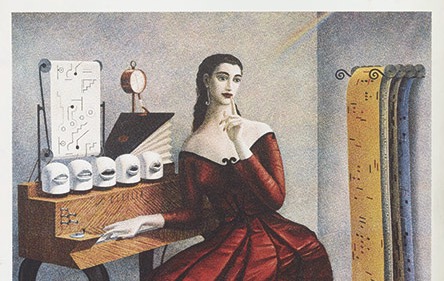
    In his painting Santa Cecilia – El Oído, Spanish artist Sigfrido Martín Begué pays tribute to the patron saint of music.

    santa cecilia patron saint of music Santa Cecilia – El Oído, Sigfrido Martín Begué (Image courtesy Mar Estrada)

    We know this is Santa Cecilia as the artist has her seated at the organ, an artistically accurate way of portraying her. Everything about this work tells us we are contemplating sound. The dog is an apparent reference to the 1898 image of “Nipper” from the Victrola gramophone ads. Notice the ear canals inside the gramophone and the five mouths articulating the vowels. Sigfrido’s use of imagery is rich in detail.

    Santa Cecilia is considering all the sounds in the room. Is she focused on the same sound the dog hears? Or is it the sound from the singing mouths when she touches the keyboard? Like the saints in the other paintings from this series, she wears a Balenciaga inspired dress.

    About Santa Cecilia

    Santa Cecilia (died c. 176 AD) originated in Rome, Italy. She was the daughter of the Roman nobility. She pledged her virginity to God. Eventually, Cecilia wed a man named Valerian out of family obligation. Having “sung in her heart to God” before her wedding, Cecilia explained to her husband that her guardian angel would harm him for defiling her virginity. Her husband asked for proof. After his baptism, he too saw the angel. He became a martyr before Santa Cecilia met her demise. After an attempt to suffocate her in the baths, someone tried to behead her unsuccessfully. She survived the severe wounds to her neck for three days. As legend has it, her body was later uncovered entirely intact. She is the patron saint of music.

    [maxbutton id=”1″ ]

    The Art of Sigfrido Martín Begué

    sigfrido martín begué almodóvar spanish painting Sigfrido Martín Begue, c. 1989 (Photo courtesy Mar Estrada)

    Sigfrido Martín Begué’s art is surreal and futuristic at the same time, drawing upon painterly techniques of Italy and Spain’s neoclassical painters. Sigfrido Martín Begué’s art is surreal and futuristic at the same time, drawing upon painterly techniques of Italy and Spain’s neoclassical painters. His work embraces modern and contemporary societal themes while deploying deeply-rooted Christian symbolism and metaphors. The artwork style recalls De Chirico and El Greco with a post-modern twist. Sigfrido’s figures are often elongated and stylized, and the color palette is bold in places and muted in others. His sense of humor and irony is evident in almost every major work.

    Sigfrigo’s portfolio included his pencil drawings to large-scale oil paintings executed with the precision of his Spanish predecessors. His paintings fit into big contemplative themes, from Los Automátas to Las Máquinas. All of the dresses depicted in the series were inspired by the fashion designs of Cristóbal Balenciaga, who opened his first clothing boutique in 1917 in San Sebastián, Spain.

    Artist Series Available for Collectors

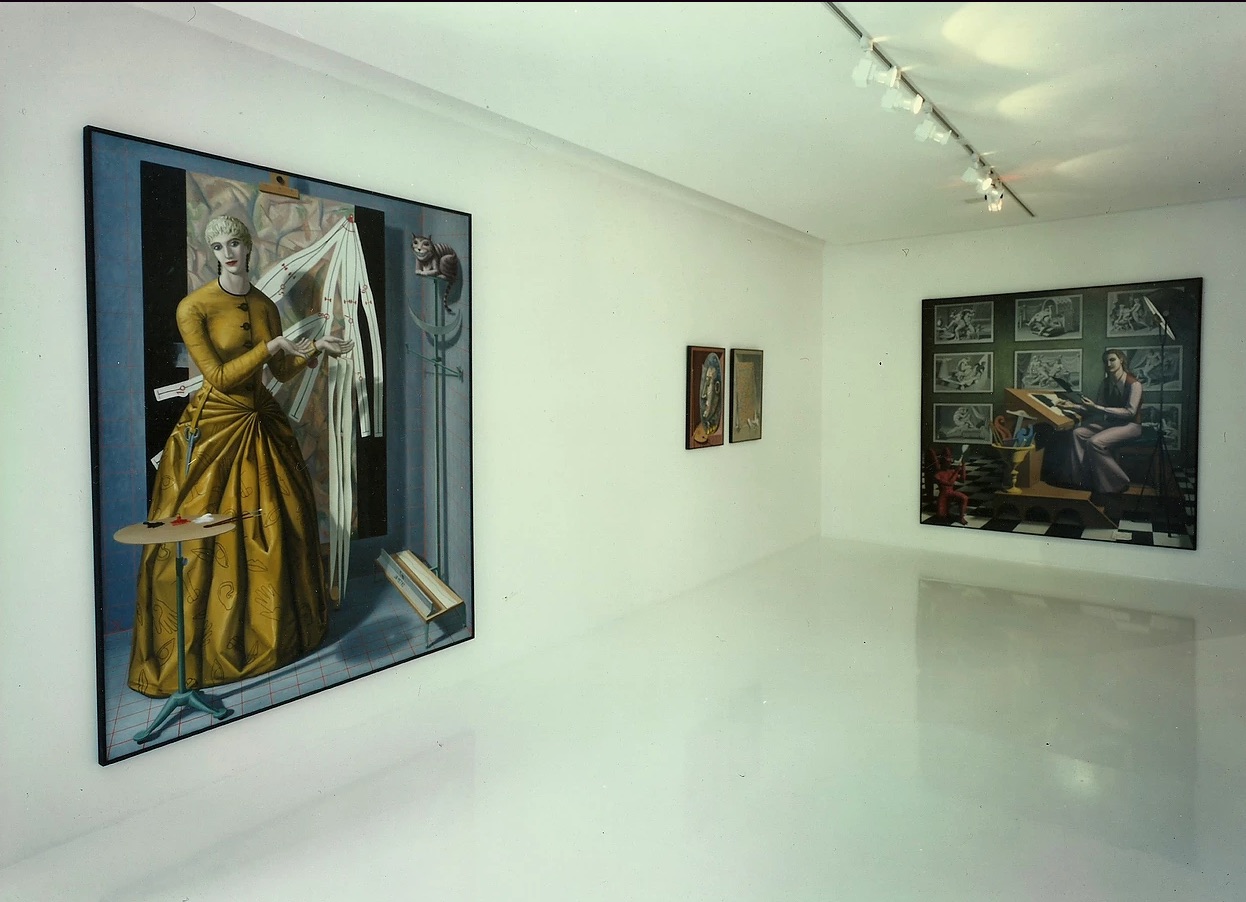
    Santa Cecilia – Begué’s (1989) was one of a series of five paintings about the senses in the exhibit Máquinas. Produced by Galería Mar Estrada, the exhibition was a solo show of Sigfrido Martín Begué’s most grandiose paintings. Máquinas was a tour-de-force display of the artist’s prolific technique. His images demonstrate fluency in history and in-depth knowledge of saints. Evident is a passion for fashion and a fascination with technology. He loved architecture, composition, and design, which are second only to his command of artistic symbolism.

    To celebrate the 30th anniversary of the exhibit Máquinas, a few signed and numbered silk-screens of Santa Cecilia – El Oído are available for purchase.

    [auction-nudge tool=”listings”]
  • The Art of Sigfrido Martín Begué

    The art of Sigfrido Martín Begué is surreal and futuristic at the same time, drawing on the painterly techniques of Italy and Spain’s neoclassical masters. His work embraces modern and contemporary themes while deploying deeply rooted Christian symbolism and metaphor.

    The style recalls De Chirico and El Greco with a postmodern twist. Sigfrido’s figures are often elongated and stylized, and his palette is bold in places and muted in others. His sense of humor and irony is evident in almost every major work. His portfolio ranges from pencil drawings to large-scale oil paintings executed with the precision of his Spanish predecessors, and his paintings fit into large contemplative themes, from Los Autómatas to Las Máquinas.

    In his Santas series, each saint represents one of the five senses, and every dress is inspired by the designs of Cristóbal Balenciaga, who opened his first boutique in San Sebastián, Spain, in 1917.


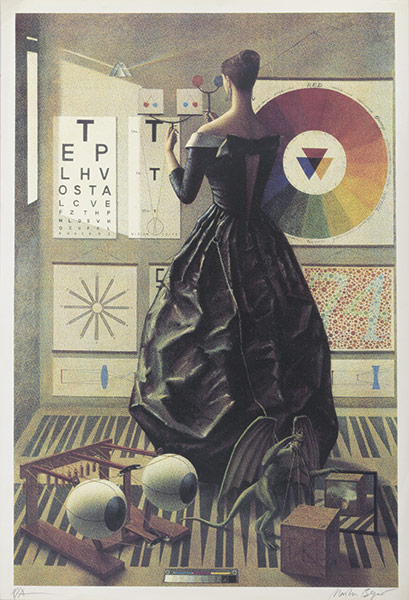
    Santa Lucía – La Vista by Sigfrido Martín Begué: a saint in a Balenciaga-inspired dress, seen from behind, taking an eye test

    Santa Lucía – La Vista

    Sigfrido Martín Begué, 1990
    Image courtesy Mar Estrada; photo by Juan Luque

    Sigfrido’s Santa Lucía – La Vista is a vibrant painting about vision. The large eyes in the foreground are the clue that this is Santa Lucía. With her back to the viewer, we cannot see her eyes at all. Like the other Santas, she wears a Balenciaga-inspired dress. She is taking a vision test, and on the wall the artist has created a gallery of eye charts and visual examinations. In the foreground, a small demon plays with the kind of visual trickery painters have long used.

    About Santa Lucía

    Santa Lucía (283–304) was born in Syracuse, Sicily, the daughter of a Roman nobleman who died when she was five. She pledged her virginity to God and gave her riches to the poor, though her widowed mother had already promised her to a wealthy pagan. When he learned that her dowry had been given away, he denounced her to the governor. According to legend, attempts to defile her and burn her at the stake failed, and her eyes were put out before her death. She is the patron saint of the blind and of eyesight.


    Santa Cecilia – El Oído by Sigfrido Martín Begué: a saint seated at an organ beside a dog and a gramophone

    Santa Cecilia – El Oído

    Sigfrido Martín Begué, 1989
    Image courtesy Mar Estrada; photo by Juan Luque

    Sigfrido’s Santa Cecilia – El Oído is a beautifully composed image about sound. We know this is Santa Cecilia because the artist has seated her at the organ, one of the traditional ways she has been portrayed. Everything in the work asks us to contemplate sound, from the dog, a nod to “Nipper” of the 1898 gramophone advertisements, to the inner workings of the machine. Notice the ear canals inside the gramophone and the five mouths on top of the organ, each forming a vowel. Is Santa Cecilia listening to every sound in the room? Does she hear what the dog hears, or the voices singing as she touches the keys? Like the other saints, she wears a Balenciaga dress.

    About Santa Cecilia

    Santa Cecilia was a Roman noblewoman who pledged her virginity to God but was married to a man named Valerian. Having “sung in her heart to God” during the wedding, she told him a guardian angel protected her. Valerian asked for proof; after his baptism he saw the angel, and he was later martyred before her. According to legend, she survived an attempt to suffocate her in the baths and lived for three days after a failed beheading, and her body was later found intact. She is the patron saint of music.


    As seen in Pain and Glory

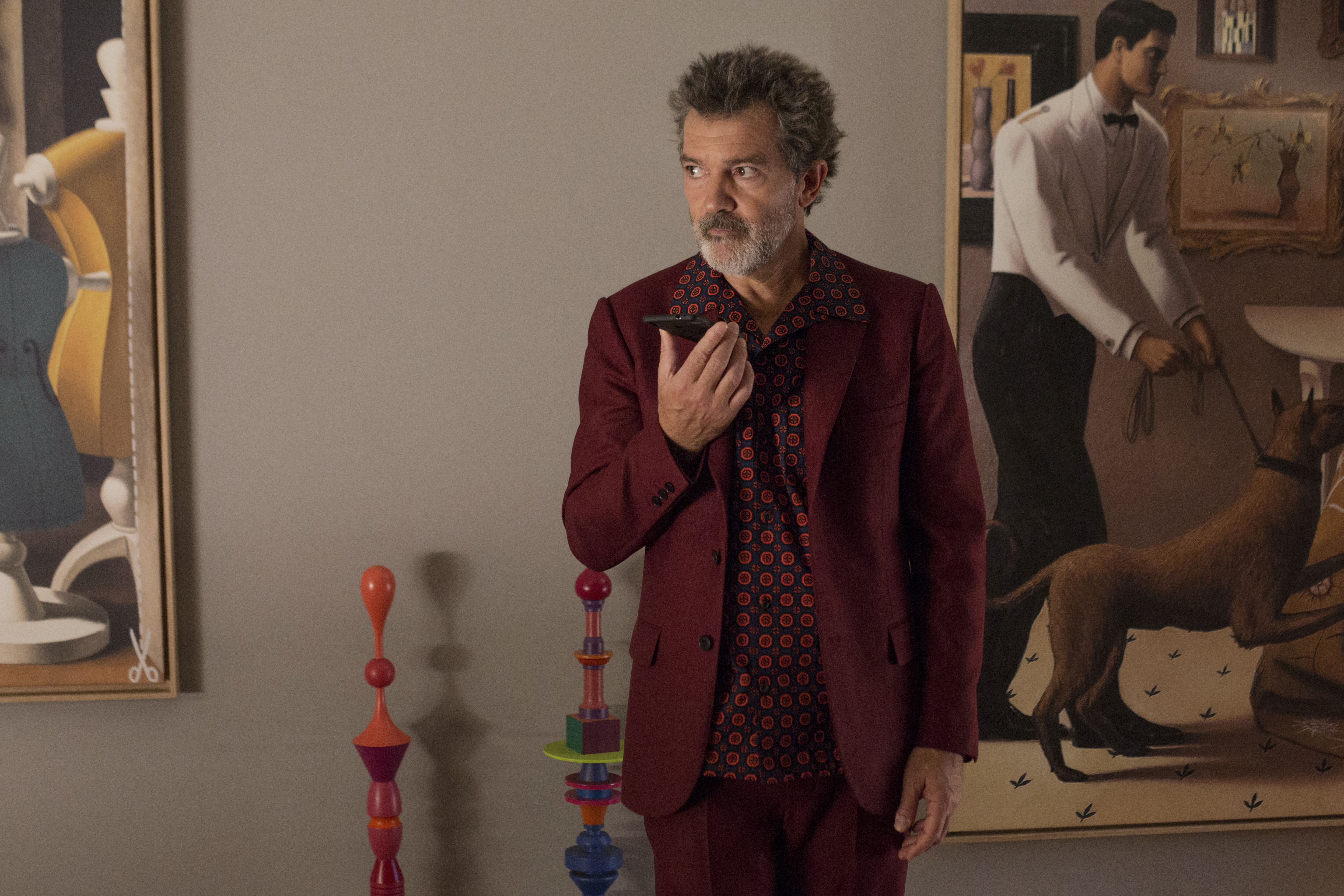
    Sigfrido Martín Begué (Madrid, 1959–2010) created two of the most prominent paintings in Pedro Almodóvar’s Pain and Glory: Las Costureras (1996) and Santa Casilda – El Olfato (1986).

    Antonio Banderas as Salvador Mallo in Pain and Glory, standing between two paintings by Sigfrido Martín Begué
    Salvador Mallo (Antonio Banderas) between two paintings by Sigfrido Martín Begué in Pain and Glory: Las Costureras (left) and Santa Casilda – El Olfato (right). Image courtesy El Deseo D.A. S.L.U., photo by Manolo Pavón.

    Read more about Sigfrido’s work in Pain and Glory · Explore his work at Universo Sigfrido

  • Suau Manages Art Gallery in Madrid

    Suau Manages Art Gallery in Madrid

    John Suau managed the Galería Mar Estrada in Madrid, Spain from 1989 to 1992. John managed the public relations and marketing, exhibit installations, and collections management. John was instrumental in creating new ways for the gallery to engage with the media and art collectors.

    sigfrido martín begué pedro almodovar pain and glory dolor y gloria antonio banderas
    Santa Cecilia – El Oído, Sigfrido Martín Begue (Courtesy Mar Estrada)

    The gallery, located in the heart of the art gallery district of Madrid, was a key player in the rebirth of the art and cultural scene in Spain in the 1980s. John managed the gallery under the direction of the founder Mar Estrada.

    Artists represented by the gallery include Sigfrído Martín Begue, Walter Dahn, Bruno Ceccobelli, María Gómez, Elena del Rivero, Dieter Fuchs, Luigi Campanelli, Roberto Cabot, Mercedes Carbonell, and Mark Dagley.

    Mr. Suau was instrumental in the gallery’s participation in international art fairs like ARTLA and ARCO.

    gallery founder mar estrada
    Mar Estrada

    John Suau was the director of my gallery in Madrid for over three years. He coordinated the gallery’s participation in international art fairs like ARCO and ARTLA. John assumed all the duties inherent to this position with a high level of professionalism. He brought creativity and possessed a deep knowledge of the art world and technology. Not only did he know how to organize all the adminstrative gallery work perfectly (art handling and registration, marketing strategies & campaign deployment, exhibition preparation and installation, international transportation needs of artists, etc.), but his extraordinary physical presence, elegance and positive and friendly manner resulted in excellent public relations for the gallery. Hard-working, efficient and extremely professional, John Suau is without a doubt a great asset to any organization.

    Mar Estrada, Founding Director, Galería Mar Estrada
    [iframe width=”100%” height=”600″ src=”https://dnf.lbn.mybluehost.me/website_51f50250/sigfrido/”]