Author: John Suau

  • Museums, Exhibits, and Digital Technology

    Museums, Exhibits, and Digital Technology

    As we begin the new year in 2021, the COVID-19 public health crisis continues to impact the museum sector: intermittent closures, widespread layoffs, and a scramble to create engaging visitor experiences, inside and outside the museum. This article explores digital technology solutions that have helped museums with visitor engagement during the crisis.

    2020 was all about digital engagement.

    From business meetings on Zoom to family and friends on FaceTime, the planet has shifted to virtual experiences for professional and personal connections like never before.

    Similarly, museums were forced to address their ability to engage audiences from a distance like never before. Prior to COVID, museum websites provided mostly general information like a directory listing for the real experience, its exhibits and programs. After being forced to close their physical spaces, the digital realm for museums came into sharper focus.

    Audience engagement with museums in 2020 was overwhelmingly digital.

    Graph of interest in virtual museum tours 2020
    “Virtual museum tours” in 2020.

    Did it peak in March? According to Google, “virtual museum tour” was one of the most popular search terms in March 2020, at the onset of COVID-19 in the US. However, the search term hit its peak in the third week of March, and interest began to wain after just one week.

    Once closures became widespread, digital resources were prioritized to provide access to exhibits and programs during closures. YouTube and 360º technology were used to create virtual tours of the museum. Web sites were built to host new digital exhibits. Finally, some new platforms have created ways to use technology both inside and outside the museum with greater ease.

    Museums 360º

    One of the most immediate responses from the smallest to the grandest of museums was to create virtual visits using 360º photos.

    Interior 360º image of Smithsonian National Museum of Natural History

    Here the virtual visitor experiences what is sometimes a strange 2D version of space.

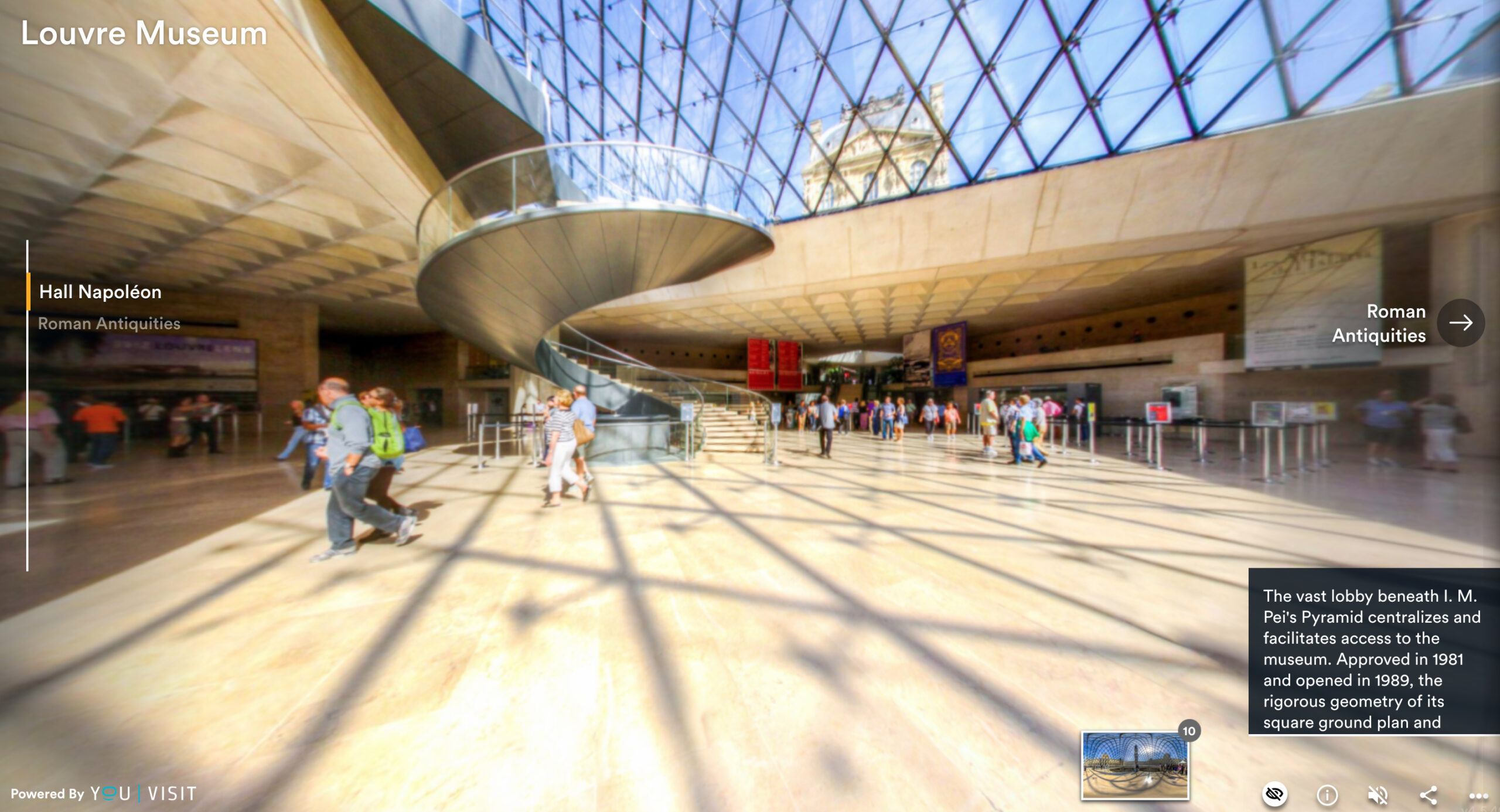
    Virtual visitors learned quickly that the experience cannot compare to the awe-inspiring feeling one gets when experiencing Frank Lloyd Wright’s spiraling galleries in the Guggenheim, I.M. Pei’s dramatic glass pyramid entrance to the Louvre, or Michelangelo’s Sistine Chapel inside the enormous Vatican museums.

    The results fall flat, and the sense of being in the space is lost in translation. There is little, if any, didactic interpretation. Navigation can be difficult from platform to platform, and the visitor may end up staring at a close-up of the marble floor without exit.

    Guggenheim Museum, New York
    Louvre, Paris
    Vatican Museums, Vatican City

    The zoom features are helpful, but without intuitive navigation or a “virtual tour guide,” the overall experience is disappointing. This technology is best left to the real estate industry.

    YouTube Videos

    Another digital resource used to recreate the real visitor experience is YouTube. Though not a new resource for museums, the production of new videos from museums small and large increased substantially during 2020.

    The Met 360° Project: Great Hall, Metropolitan Museum of Art, New York

    Like the Metropolitan Museum of Art in New York, many museums used 360º videos to guide virtual visitors through the museum using videos on YouTube.

    While offering a more structured way to direct visitors through virtual spaces than the 360º technology above, the experience is still not the same as standing in front of great art.

    However, YouTube provides museums with a platform for content that can be used to engage new audiences in unique and targeted ways. Three examples below include MoMA‘s virtual view of Van Gogh’s “Starry Night,” with Anna Deavere Smith’s reading of a letter from the artist to his brother, Theo. The Rijksmuseum created a series of YouTube videos called “Is It Art?” which examine contemporary artistic creations with more traditional art forms from the museum’s collections as a way of drawing younger audiences into the decisions of labeling them “art”. Finally, London’s National Gallery used YouTube to create a 5-minute meditation with Odilon Redon’s painting as its visual background.

    Museum of Modern Art, New York

    Rijksmuseum, Amsterdam

    The National Gallery, London

    All of these videos deliver content to audiences far and wide. Their success depends on their dissemination. Most museums use their social media outlets to market this content.

    Online Exhibits

    Less pervasive but equally important are online exhibits. These digital stories provide virtual visitors with learning opportunities outside the museum.

    Smithsonian National Portrait Gallery, Washington, DC

    For the curator and educator, these exhibits provide ways to organize and present collections in an evergreen format with the ability to edit and update content as the exhibit ages. The Smithsonian National Portrait Gallery‘s exhibit “First Ladies of the United States” is a great example of this type of exhibit.

    Free from the limitations of physical space, these exhibits allow museums to create more robust learning resources for the public. They often feature artworks that may not be visible to the public, even when open.

    Many of these digital experiences incorporate audio and video media. Some use creative ways of presenting the information. What is unique about these exhibits is the lack of a physical exhibit. The experience is designed to be completely virtual. The Museum of Modern Art organized an online exhibit about drawing in the 20th Century as the permanent online exhibit reflecting the museum’s real exhibit which was on view from November 21, 2010, to February 7, 2011. The Smithsonian Renwick Gallery was forced to close Janet Echelman’s “1.8 Renwick” exhibit shortly after it opened in 2020. It created a website to show the exhibit online until it reopens in 2021. The Smithsonian Cooper-Hewitt Design Museum used a website to curate content for “Willi Smith – Street Couture” an exhibit that lives on thanks to digital communications.

    Museum of Modern Art, NYC
    Smithsonian American Art Museum, Washington, DC
    Willi Smith: Street Couture exhibit
    Cooper-Hewitt, Smithsonian Design Museum, NYC

    The success of these online exhibits depends on each site’s accessibility and navigation. They can require substantial resources, including hours of research by curators, the scripting by educators, and time for production by technology teams. Their visibility depends upon the integration of the museum’s digital and marketing strategies.


    Spotlight: The Queen and The Crown

    One of the best examples of an online exhibit is the Netflix and Brooklyn Museum exhibit “The Queen and The Crown”.

    Netflix and the Brooklyn Museum

    Drawing on the popularity of “The Crown,” the exhibit launched just a few days before the 2020 season premiere.

    The exhibit resolves the usual spatial and navigational issues experienced in most virtual exhibits with short video clips and intuitive navigation. There is quiet music playing in the background, and the swooping noises help reassure successful navigation. The mannequins with the dresses can spin around, as the arrows indicate. It has a very smooth transition from a 360º museum experience to an online exhibit providing the visitor with a unique way to engage and learn.

    Using pop-up pages for details, the site sound effects in the background add to the sense of a reverberant museum hall. Overall, this online exhibit is one of the best of its kind.


    Smartify Virtual Tours

    Guided tours lead by a docent or museum device audio guides were standard experiences before COVID-19 began to shut down museums everywhere.

    Smithsonian National Portrait Gallery, Washington, DC

    Like the Smithsonian National Portrait Gallery, many museums have created audio tours of specific exhibitions. Most large art museums provided handheld devices in several languages. With the onset of COVID, docent-led tours and handheld devices have become obsolete. The health crisis has also made museums acutely aware of the risks involved with interactive exhibits – from audio guides to touch screens.

    Smartify is a digital channel that delivers museum content to users’ devices via a web app as well as a mobile app. Started five years ago, the company currently hosts over 120 museum partners from around the world.

    Prior to COVID-19, Smartify was focused on the mobile experience. The scan-to-learn technology allows users to scan the artwork to learn more on smart devices. With COVID-19, the company expanded the delivery of content to a web app so that the tours could be more easily disseminated through digital channels and social media outlets.

    Using cloud-based software, museums are able to upload their digitized collections into the platform and then transform their content into meaningful stories using the tour building features. Tours can be designed for the general public, like the National Portrait Gallery’s tour above and they can be delivered in as many languages as the museum wants. Or, they can create audience-specific experiences using customized tours.

    For example, the Nelson-Atkins Museum of Art used Smartify to create a wonderful ASL tour for its deaf communities using videos of sign interpreters. The British Museum created a tour exploring LGBTQ histories using its collections.

    Finally, one of the best things about the Smartify platform is its universality. Once a museum reopens, the visitor can still use Smartify inside the museum to access the tours and more. The Belvedere Museum in Vienna used Smartify to replace its handheld devices when it reopened in the summer of 2020 in an effort to reduce the risk of the spread of COVID.

    Nelson-Atkins Museum of Art, Kansas City
    The British Museum, London
    Belvedere Museum, Vienna

    The resulting experience via the Smartify platform is well-designed and allows for media files to be added, making use of YouTube videos and external content to add to the robustness of the content.

    Conclusion

    In retrospect, museums have used as many resources as possible to continue to connect with their communities. From 360º virtual tours to Smartify, each platform adds new ways to reach audiences with their content whether on a laptop at home or on a mobile device inside a museum.

    What is important for museums in 2021 is to continue to develop and deliver content via as many channels as possible. The ability to manage resources while providing a great visitor experience requires attention to the continued impact that COVID-19 will have on our lives into the new year and beyond. As they continue to evolve with their partners’ needs, digital platforms like Smartify provide museums with the best tools for any scenario.
  • Almodóvar, Banderas, and the Saints of Sigfrido Martín Begué

    Modern art plays a prominent role in the newest Pedro Almodóvar film, Pain and Glory. Antonio Banderas portrays Salvador Mallo, a successful film director in Madrid with a penchant for modern art. Like Almodóvar, Salvador’s success affords him an outstanding private art collection.

    Antonio Banderas delivers what may be his most sublime performance to date in “Pain and Glory,” a film that delves deep into the intricacies of life’s trials and the profound nature of creative expression. This narrative stands as a testament to the enduring partnership between Banderas and the acclaimed filmmaker Pedro Almodóvar—a collaboration that has spanned decades and produced a myriad of cinematic treasures.

    In “Pain and Glory,” Banderas embodies the role of the protagonist, a director who navigates through a series of introspective episodes that mirror Almodóvar’s personal history, blending the lines between the character’s fictional existence and the director’s own reality. It’s a portrayal brimming with authenticity and emotional depth, which not only showcases Banderas’s versatile acting chops but also reverently acknowledges the intimate relationship between a director and his muse.

    The film’s narrative structure is a mosaic of memories, regrets, and reconciliations, all of which coalesce into a portrait of an artist at a crossroads. Banderas, with a meticulous attention to the minutiae of emotion and movement, crafts a character that is both a figure of reverence and a deeply flawed human being, making the performance all the more gripping.

    Beyond the individual triumphs of Banderas, “Pain and Glory” also serves as a cultural landmark within the filmographies of both actor and director, marking a moment where their collaborative synergy reaches its zenith. This movie is not just a story told on screen—it’s a piece of living art, inviting viewers to empathize, reflect, and even find pieces of their own life stories within the frames of this poignant film.

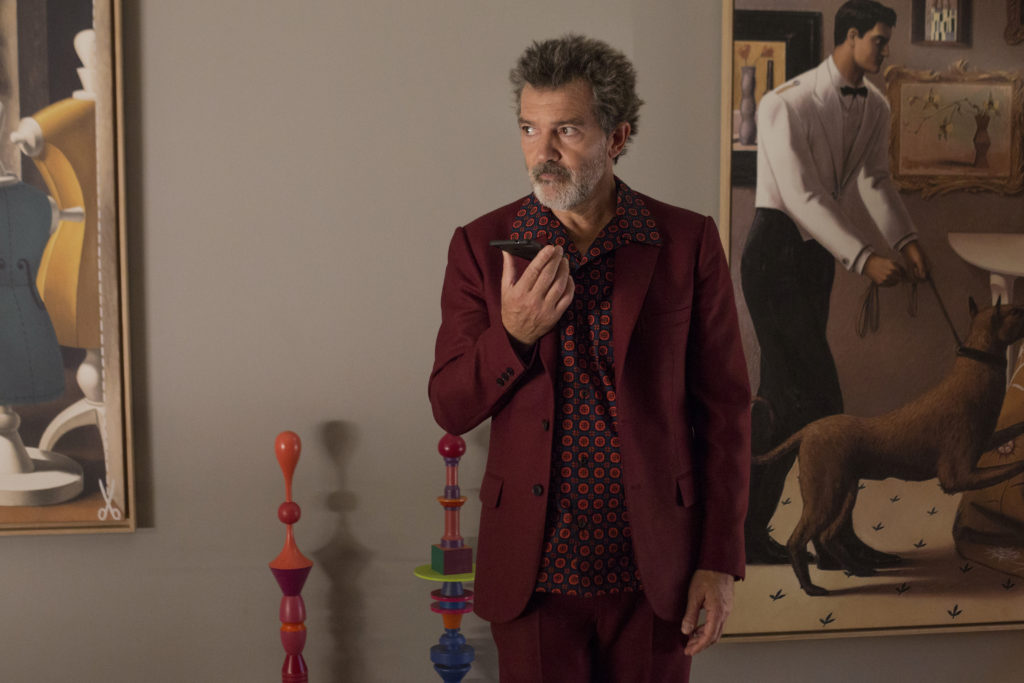
    Antonio Banderas as Salvador Mallo in Pain and Glory, standing between two paintings by Sigfrido Martín Begué
    Salvador Mallo (Antonio Banderas) between two paintings by Sigfrido Martín Begué in Pain and Glory: Las Costureras (left) and Santa Casilda – El Olfato (right). Image courtesy El Deseo D.A. S.L.U., photo by Manolo Pavón.

    It’s worth noting that the impact of Banderas‘s performance is enhanced by his history with Almodóvar. Having launched his career in “Labyrinth of Passion,” Banderas has evolved as an actor alongside Almodóvar’s growth as a filmmaker. This synergy is palpable in “Pain and Glory,” their eighth film. Their collective history imbues the narrative with a depth that resonates with those familiar with their work.

    In “Pain and Glory,” Antonio Banderas embodies the emotional and physical tribulations of aging with a visceral sincerity. The character grapples with a spectrum of emotions from regret to reminiscence, and the portrayal is imbued with a poignant realism. The pains of aging, as experienced by the character, reflect a universal human experience, making the film deeply relatable.

    The narrative weaves through the protagonist’s past and present, highlighting the layers of his identity as an artist and as a gay man facing the twilight years of his life. Banderas not only succeeds in captivating the audience with his Oscar-worthy portrayal but also offers an insightful gaze into the soul of an artist. His performance pays homage to the rich complexity of Almodóvar’s “auto-fictional” character, making “Pain and Glory” an unforgettable experience in contemporary cinema.

    Spain in the 1990s

    The cinematic landscape of post-Franco Spain is vividly brought to life through the films of Pedro Almodóvar, among other creative talents emerging during this dynamic period of cultural reawakening. The country, having endured a long period of repression under Franco’s dictatorship, experienced a flourishing of creative expression that echoed through cinema, literature, art, and architecture following the dictator’s death in 1975.

    This renaissance was not only evident in high culture but also seen in the streets and lives of the Spanish people, who embraced newfound freedoms with a vivacious spirit that would come to be known as La Movida Madrileña. This movement, with Madrid as its epicenter, encapsulated a societal urge to break free from the conservative shackles of the past, and it fostered an environment where artists like Almodóvar could thrive.

    The movie in question, reflecting this era, showcases Spain’s rapid modernization and the exuberance of its people. The characters and their environments are painted with a palette that speaks to this zeitgeist—a bold and liberal use of color, form, and texture that could be seen in the urban landscape and in the private spaces of the Spanish citizens.

    By the time 1992 arrived, Spain was ready to present itself on the world stage as a nation reborn. Barcelona’s hosting of the Olympics was a sporting spectacle that also highlighted the city’s architectural marvels, from Gaudí’s Sagrada Familia to the contemporary structures developed for the games. In the same breath, Seville’s EXPO’92 served as a global exposition of the world’s cultures and innovations, with Spain demonstrating its leadership in various fields. Madrid, as the Cultural Capital of Europe in 1992, affirmed Spain’s position at the forefront of the arts. The city showcased a kaleidoscope of cultural achievements that year, from art exhibitions to theatrical performances, and pulsated with the creative energy that had been building up over the past decades.

    The notion that a character’s home in the movie would take its inspiration from Pedro Almodóvar’s actual residence is a testament to the director’s personal influence in defining the aesthetic of the era. His home, much like the sets of his films, would presumably be a microcosm of this broader cultural evolution—a place where avant-garde meets tradition, and the boldness of La Movida is encapsulated within the walls of an intimate, personal space. Through the characters’ lives and the spaces they inhabit, viewers are given a window into a transformative time in Spanish history that still echoes in the nation’s contemporary culture.

    The director’s art collection heralds a time when La Movida M__adrileña counted both Pedro Almodóvar and Sigfrido Martín Begué among its leading creative figures.  Sigfrido Martín Begué (Madrid, 1959-2010) created two of the most prominent paintings in the film, Las Costureras (1996) and Santa Casilda – El Olfato (1986). Together, they make a stylish and bold Spanish backdrop to the unfolding drama. It comes as little surprise to those of us who knew Sigfrido that his art would figure so prominently in Almodóvar’s films. The two were good friends. Pedro Almodóvar attended Sigfrido’s art exhibits, and Sigfrido was always present at Almodóvar’s film premiers in Madrid. As a result, Sigfrido’s work has appeared in several of Almodóvar’s films but never so prominently as in Pain and Glory.

    Santa Casilda – El Olfato

    Santa Casilda – El Olfato (art as seen in Almodóvar’s Pain and Glory)) was part of an intricate series of five paintings by the revered artist Sigfrido Martín Begué, each an ode to the human senses. This particular piece garners special attention due to its sundry artistry and layered meanings. It was first unveiled to the public in the engaging exhibit Máquinas held at the Galería Mar Estrada. Máquinas wasn’t just any ordinary display; it embodied Begué’s bold vision and a showcase highlighting the zenith of his artistic journey.

    Begué’s portfolio displayed during this solo exhibition was nothing short of a visual lexicon of his multifaceted skills. Expertly weaving through different artistic periods, he imbued traditional narratives with modern ethos. Through Santa Casilda – El Olfato, Begué fused the historic and the contemporary, paying tribute not just to one sense, but encapsulating a full spectrum of sensory experiences. The series elaborates on themes as varied as the historical recognition of saints and as modern as technology’s role in today’s society.

    One could infer a subtle interplay between the ethereal and the material in his work. Fashion and technology—often seen at polar ends of the cultural spectrum—are amalgamated to reflect society’s changing values and its constant quest for innovation and aesthetics. The architectural elements in the pieces demonstrate Begué’s firm grasp on structure and form, showing that the arrangement of space is as crucial to the narrative of a painting as its subject and palette.

    The composition and design of each painting are meticulously crafted to evoke deep contemplation, illustrating not only Begué’s command of artistic symbolism but also his sagacity in layering multiple elements to produce a coherent and impactful body of work. His paintings are an invitation to dive deep into the depths of history and rise to the surface clad in contemporary understandings. With works such as Santa Casilda – El Olfato, Sigfrido Martín Begué has undeniably etched his name into the annals of art history.

    Sigfrido’s Santa Casilda – El Olfato is a luxurious painting about the sense of smell. We know this is Santa Casilda because the artist has placed a loaf of bread in her Balenciaga-inspired dress. She is protecting the bread from an aggressive dog, obviously attracted by the aroma of the bread. Behind her, a gallery of floral paintings provokes the idea of their sweet smells and reminds us of the olfactory sense. Finally, one sees a small perfume bottle on the table to remind the viewer that this is Santa Casilda.

    The Art of Sigfrido Martín Begué

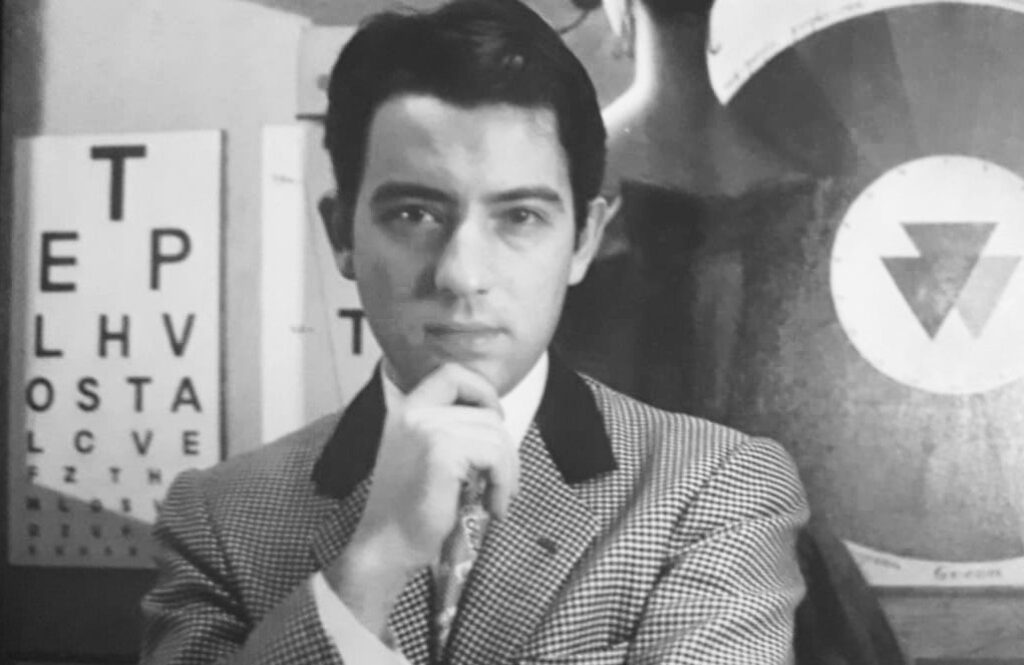
    Portrait of the artist Sigfrido Martín Begué
    Sigfrido Martín Begué (Madrid, 1959–2010)

    Sigfrido Martín Begué is an artist whose work is an intriguing juxtaposition of the surreal and futuristic, heavily influenced by the painterly techniques honed by Italy and Spain’s neoclassical masters. Every brushstroke reverberates with a profound understanding of these classical traditions, yet his visions are firmly planted in the present and future, creating a bridge across time through art.

    His oeuvre tackles modern and contemporary societal issues. Yet, it does so with an ever-present nod to Christian symbolism and metaphoric storytelling — tools that infuse his art with layers of meaning. The powerful yet graceful references to religious iconography are not blunt; instead, they are woven seamlessly into the narrative of each piece, asking the viewer to look deeper and engage with the undercurrents of faith and spirituality that flow beneath the surface.

    Begué’s stylistic choices recall the dramatic tension and metaphysical musings of De Chirico and the distinctive, spiritually charged figures of El Greco. However, he adds a distinct post-modern flair to this lineage that sets his work apart. His figures are often elongated, elegantly distorted echoes of the human form that are at once familiar and alien. This stylization is not merely aesthetic but rich in meaning, creating a visual dialogue about the human condition and its flexibility in the face of societal pressures and existential dilemmas.
    Sigfrido’s palette is as varied as it is deliberate—bold hues command attention in one instance, while muted tones suggest introspection and calm in another. This choice of colors is strategic, designed to guide the viewer’s emotional response and highlight thematic elements within each composition.

    Yet, despite the weighty themes and classical influences, there is an unmistakable undercurrent of humor and irony in much of Sigfrido’s work. This deft touch invites the viewer not only to contemplate and reflect but also to find joy in the absurdity and contradictions of life.

    His portfolio showcases a range and depth of talent, from delicate pencil drawings highlighting his meticulous attention to detail to grand, large-scale oil paintings that call to mind the exquisite and exacting works of his Spanish predecessors. Each piece feels like a crafted world unto itself, with themes that evoke deep contemplation — from Los Automátas, a commentary on the mechanization of humanity, to Las Máquinas, a meditation on the relationship between man and the machinery of his creation.

    In a unique blend of art and fashion, his Santas series pays homage to the high couture of Cristóbal Balenciaga, with each saint’s dress meticulously inspired by the groundbreaking designs of the renowned fashion icon. Balenciaga, who forged his path in the fashion world by opening his boutique in 1917, seems a fitting muse for Sigfrido’s art, which is unafraid to break molds and transcend boundaries.

    The Art of Pain and Glory

    The film Pain and Glory, directed by the illustrious Pedro Almodóvar, stars renowned actors Antonio Banderas and Penelope Cruz, and has been commanding the attention of cinema enthusiasts with its compelling narrative paired with a striking aesthetic. The movie is not merely resting on its laurels; instead, it continues to harvest a wealth of positive critiques and accolades from various critical spheres. One undeniable impact of the film has been to refuel the conversation around the works of Sigfrido Martin Begué, whose unique artistic lexicon is receiving renewed examination and appreciation.

    Through Almodóvar’s cinematic lens, audiences are offered a glimpse into a world suffused with color and emotional depth, reminiscent of Begué’s own artistic endeavors. Just as the artist’s creations distill stories into palettes and forms that evoke a poignant response, Almodóvar’s film achieves a similar resonance through its visual storytelling. Both the artist and the filmmaker share an avidity for communicating narratives that transcend conventional norms—instead, they opt for a polyphonic palette of emotions and hues.

    Almodóvar’s craftsmanship in Pain and Glory celebrates life’s spectrum, from the agonizing depths of a character’s experience to the exhilarating peaks of creative euphoria. Banderas’s portrayal is a testament to Almodóvar’s ability to extract deeply personal performances from his actors, while Cruz’s participation adds a layer of authenticity and charm. Beyond its immediate narrative, the film prompts a broader dialogue about art, memory, and the indelible marks that both leave on the human experience.

    Pain and Glory stands not just as a singular piece of cinematic art but also as a beacon that illuminates the works of visionary artists like Sigfrido Martin Begué. It is a clear demonstration of the power of film to act as a conduit for the renaissance of interest in different art forms, encouraging audiences to explore the myriad ways stories can be told and experienced. Almodóvar, ever the auteur, proves once more that cinema can create a tapestry of life as complex, vibrant, and profound as the artworks that inspire it.

    Learn more about the art of Sigfrido Martín Begué

  • Smartify: AI technology for all museums

    Smartify: AI technology for all museums

    Smartify is a free app that scans art and provides access to content in museums and galleries. Smartify users can also use it to build a personal art collection from some of the world’s best museums. Additionally, the augmented reality (AR) feature allows users to see the art in their homes. 

    smartify art app scans art
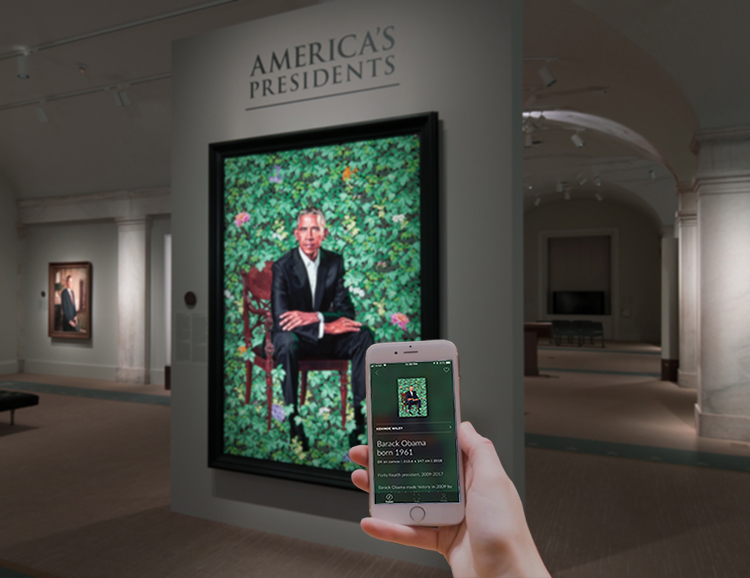
    Smartify works in the Smithsonian National Portrait Gallery’s Hall of Presidents. Pictured here is the portrait of President Barrack Obama.

    I first learned about the museum app Smartify at the Smithsonian National Portrait Gallery in front of the portrait of President Barrack Obama. There was a sign to download an app. I could deploy as a scanner on my iPhone to learn more about the Presidential portraits. I quickly downloaded it and scanned the art, and it worked. What a thrill!

    A few weeks later, I created a partnership between Smartify and the Historical Society of Washington, DC., where I was the executive director.  The platform was a perfect solution for the new museum. The goal was to deliver information about the history of the Carnegie Library to personal mobile devices. The app can be used throughout the DC History Center. Plans include expanding the content to allow scans of sculptures in and around the building.

    Scan Art Not QR Codes – Behind the App Technology

    This app eliminates the need to scan QR codes. It uses technology to recognize the art itself. This technology works on smartphones and mobile devices. And it is an art guide that provides information instantly. It works across venues and is easy to use. Smartify is a social enterprise that serves a global community of art venues, artists, and art lovers. It’s the one app you can use to scan artwork to discover content for museums around the world. 

    Case Study: Carnegie Library at Mount Vernon Square

    Carnegie Library at Mt. Vernon Square is a history exhibit about the 1903 Carnegie Library in Washington, DC. Produced in partnership with Apple, the permanent exhibition is in the Carnegie Gallery on the lower level. Originally called the “bicycle room” when it opened, the room was meticulously restored in 2019 by Apple.

    carnegie library
    Carnegie Gallery, Carnegie Library at Mt. Vernon Square

    With dramatic ceramic ceilings by Rafael Guastavino, the exhibit space includes sixteen images. They benchmark moments from the building’s 115-year history. These include conceptual designs, blueprints, and other images from the 70 years as the public library. The exhibit concludes with the 2018 renovations by Apple.

    The complete history is available at the DC History Center website. Here, learners can find the full and unedited version of the history of the 1903 Beaux-Arts building. The website includes the history of the selection of Washington, DC, as the site for the new capital city and Peter L’Enfant’s design of the District.

    To enhance the minimal content on the exhibit walls, the Historical Society partnered with Smartify to deploy additional historical images and text to visitors’ mobile devices. Visitors scan any one of the 16 images to gain access to more information. The partnership with Smartify resulted in increased visibility of the DC History Center and allows visitors to support the organization with memberships and donations.

    The platform is developed in partnership with art museums worldwide, including the Smithsonian National Portrait Gallery in Washington, DC, The Mint Museum in Charlotte, NC, and the Metropolitan Museum of Art in New York City, and many more.


  • DC Hall of History

    DC Hall of History

    John Suau conceived and directed the creation of the opening exhibit DC Hall of History, a central exhibit about the history of Washington, D.C., as portrayed by the Historical Society collections. John was the executive director of the Historical Society of Washington, D.C., in 2019, when the organization launched the DC History Center.

    Design Problem

    The space for this exhibit is very small. It is a long narrow hallway with very low ceilings. In the redesign of the building with Apple, the space would prove the most challenging. However, the exhibit “DC Hall of History,” is a pivotal exhibit for the Historical Society.

    Design Solution

    John Suau worked with Healy|Kohler Design to develop a solution for the exhibit about the history of Washington, D.C. using the collections of the Historical Society. The design solution was a wall-mounted light box and a series of four custom made display cases. Together, they provide a maximum impact on the visitor.

    John’s experience, knowledge of space design and his problem solving skills proved valuable in the creation of a visitor experience that is engaging and didactic. Furthermore, the exhibit provides educators a template from which to create a number of topics, including local commerce, transportation, leisure time in Washington, and the built environment.

    The exhibit includes a timeline which incorporates display techniques reminiscent of the Apple store downstairs. Custom display cases hold materials from the collections of the Historical Society and there is a mural map that highlights local museums and libraries with collections related to Washington history. The mission of the organization is prominently displayed over a photomontage of the organization’s public programs and exhibits.

  • DC History Center

    DC History Center

    digital marketing strategist
    John Suau

    Created over five years, the DC History Center, an urban history center in the US, opened on May 11, 2019. The center includes a library and a museum and is operated by the Historical Society of Washington, D.C. Founded in 1898, the society has long struggled to find the “right-size” home to support its mission in Washington.

    The Historical Society closed in 2011 due to a lack of funding and was without a director for three years. After a two-year search, the Historical Society hired John Suau. Under his leadership, a beautiful new destination for DC history was created. The American Architecture Awards recently named Apple’s transformative restoration of the Carnegie Library the best restoration of 2020. With the support of technology, its transition into a 21st-century urban history center is finished.

    Digital Communications

    Rebranding the organization

    Creating a new digital footprint with a cost-efficient blog website enabled easier integration with other digital marketing tools.

    The organization was rebranded as @dchistory to strengthen the brand consistently across Twitter/X, Instagram, and Facebook.

    Exhibits

    Creating new exhibits enlivened community participation and engaged artists and photographers in the Historical Society’s work.

    For the Record is one example. This was a crowd-sourced exhibit program about documenting the built environment of contemporary Washington, D.C. A group of museum curators juried the exhibition. It rapidly grew into one of the local community’s most engaging exhibits. From 2017 through May 2019, the Historical Society vacated the Carnegie Library to restore it.

    During the restoration, community partners played a crucial role. The Newseum, the National Building Museum, and the George Washington University Museum provided program and operation space. This allowed for continued engagement with the local community.

    Public Programs

    Partnerships with community organizations are an important part of the new DC History Center. These partners enhance programs and bring new and diverse audiences to the new DC History Center. In 2014, the society partnered with the Smithsonian National Museum of African American History and Culture (NMAAHC). They hosted the final edition of “Saving Our African American Treasures.”

    The DC History Center produced numerous public programs, including tours, workshops, and speaker series. The annual DC History Conference partnered with the DC Public Library and the George Washington University Gelman Library. It worked with the National Archives. The University of the District of Columbia also collaborated. The Smithsonian National Museum of American History was included as well.

    Community Partnerships

    Community partnerships expanded the organization’s reach by establishing strategic alliances with local organizations. Partnerships include the Capital Pride Alliance and the DC Public Library. Other partners are the DC Preservation League, the George Washington University Museum, the National Archives, and the National Building Museum.

    Collaborative relationships were formed with museum colleagues at the Smithsonian Anacostia Museum. Additionally, we connected with colleagues at Smithsonian Associates. We also reached out to the Smithsonian Latino Center and the Smithsonian National Museum of African American History and Culture.

    The Historical Society developed a long-term strategic partnership with the DC Office of Planning. This partnership helped to develop HistoryQuest DC. It is an interactive map with historical data on approximately 127,000 buildings in Washington, DC.

    The map offers many layers of information for the user. The website provides historical data on individual buildings. It also links to information about properties on the National Register of Historic Places.

    Fundraising and Grants

    A complimentary program, the Visionary Historian Award, was established to create a second fundraising event recognizing local historians.


    Together, the award programs increase the organization’s visibility and elevate the brand across the city. The events raised 10-15% of the organization’s annual budget. Augmented support from DC government agencies like the DC Commission on the Arts and Humanities and HumanitiesDC bolstered public support. Project grants from the Office of Planning also contributed. Overall, public support increased by more than 2300%. 

    Corporate Partnerships

    Apple and the Carnegie Library Restoration

    DC History Center

    This new facility includes three exhibit galleries, a research library, a retail store, offices, and state-of-the-art collection storage facilities. From rebranding to a successful partnership with Apple, the DC History Center is now a 21st-century cultural hub. It welcomes all visitors for free, advancing the mission of the Historical Society.

    selma thomas
    Selma Thomas, Museum Consultant

    John brought both vision and good management to the Historical Society and with his professional background and contacts, turned an archaic institution into a vibrant player in the city’s cultural scene.

  • Carnegie Library at Mount Vernon Square

    Carnegie Library at Mount Vernon Square

    Carnegie Library at Mount Vernon Square

    Carnegie Library at Mt. Vernon Square is one of three new exhibits in the DC History Center. This small exhibit is about the history of the iconic landmark 1903 Carnegie Library in Washington, D.C. Produced in partnership with Apple, the exhibit is located in the Carnegie Gallery on the lower level. History tells us that when it opened in 1903, this room originally served as the “bicycle room”.

    With its dramatic Rafael Guastavino ceramic ceilings, the exhibit hall includes sixteen images. Each one benchmarks a moment in the building’s 115-year history, including conceptual designs and blueprints. The exhibit documents seventy years of use as the public library, and it ends with the renovations by Apple.

    Museum-goer scans to learn more.

    To complement the two exhibits, the Historical Society partnered with Smartify to deploy content via mobile devices. Visitors can scan any one of the 16 images in the exhibit to learn the story behind each image.

    The partnership with Smartify has resulted in increased visibility of the DC History Center. Similarly, the app allows users to support the organization via a link to donate or join as a member.

  • THE BIG PICTURE

    THE BIG PICTURE

    John Suau conceived and created THE BIG PICTURE, the inaugural exhibit of the new DC History Center. The project presented an opportunity to open a new gallery space in a restored historic landmark building that was being restored by Apple with an unknown timeline.

    Design Challenge

    As outlined above, the project had a short and moving timeline. The restoration began in August 2017. The entire operations of the Historical Society were relocated to the Newseum including the majority of the collections. The remainder were relocated to offsite storage facilities. The target opening date was December 2018. However, building renovations were difficult. As in most historic restoration projects, surprises were found and delays ensued.

    Working with a very tight timeline, there were also limited resources available. John Suau created new funding opportunities for local companies to sponsor, with THE BIG PICTURE as a big part of the package. The unknown reopening date prevented the establishment of a stable environment for collections. The design solution would require an exhibit with reproductions with maximum visual impact and broad programming options.

    Exhibit Content

    Since he started in March of 2014, John Suau had been fascinated with the Capitol Photo Service collection of the Historical Society. With over 3,500 panoramic images dating from the early 1900s, Suau worked closely with a photo editor and contract researchers to select 70 images that would best serve for this exhibit. These images were curated and reproduced in various formats, from large analog screens to digital formats for touchscreens. The results provide dramatic and diverse stories that convey the rich history of Washington, D.C.

    From the DC History Center

    suau creates history exhibit
    THE BIG PICTURE exhibit

    “In the first half of the 20th century, photographers recorded milestones using panoramic technology. Very few people alive have seen them. Until now.

    THE BIG PICTURE reveals how these craftsmen captured DC history. From Rudolph Valentino’s visit to the White House to the 1924 World Series Championship, these magnificent panoramic photographs document visiting celebrities and moments of great pride.

    They celebrate the District of Columbia’s highs, acknowledge its lows, and reveal everyday life. THE BIG PICTURE presents more than 70 of the resonant images to take you back to the Washington you remember and the one you never knew. Come see these images–-several of which are blown up so large that you’ll feel like you’re a part of them–for a completely new experience of Washington’s past. THE BIG PICTURE is the context for today’s richly diverse DC, the familiar, the surprising, and the beautiful.”

    Design Solution

    John Suau found the solution in the creation of giant light boxes for mounting (and backlighting) large reproductions from a huge collection of panoramic images. Five of them were enlarged to over forty feet long and nine feet high.

    To complement the large images, the exhibit includes additional digital images. Several are featured on the opening digital screen, rolling across the screen slowly. Four groups of over a dozen more images are presented on touchscreens. These allow visitors to “pinch and zoom” so they can examine the rich details of the giant images. The exhibit includes over 70 different images. The photographs portray people, places, and events throughout the 20th century.

    The design concept was based on a visit to the Missouri Historical Society in St. Louis. A state-funded institution, they had recently opened a new exhibit, Panoramas of the City. A similar history exhibit that featured panoramic images of St. Louis, the format was ideal for the new exhibit in the DC History Center. The Historical Society boasts over 100,000 panoramic images in the Capital Photo Service collection. Using these large analog negatives, the images could be magnified to huge prints thanks to the originals’ resolution. They provided a fascinating window into the history of urban life in the 20th century.

    The majority of the Historical Society’s images are documentaries of school groups, dances, meetings, reunions, and White House visits dating from the early 1900s to the 1990s. The Capital Photo Service Collection was a part of the Historical Society. The Fred Schutz Collection, which holds the oldest collection of Washington panoramic images, are part of the Panoramic Images Collection. Thanks to a partnership with Panoramic Images, the exhibit included some of the most dramatic and iconic images of Washington, D.C.

    John Kelly

    …the real draw right now is the DC History Center’s inaugural exhibit, “The Big Picture.” They don’t get much bigger. Because the negatives are so large — eight inches high — they can be blown up super big. A few have been printed on seamless fabric nine feet high and 40 feet wide. The fabric is mounted on curved light boxes. The effect is mesmerizing.

    John Kelly, The Washington Post, May 12, 2019

  • Washington History

    Washington History

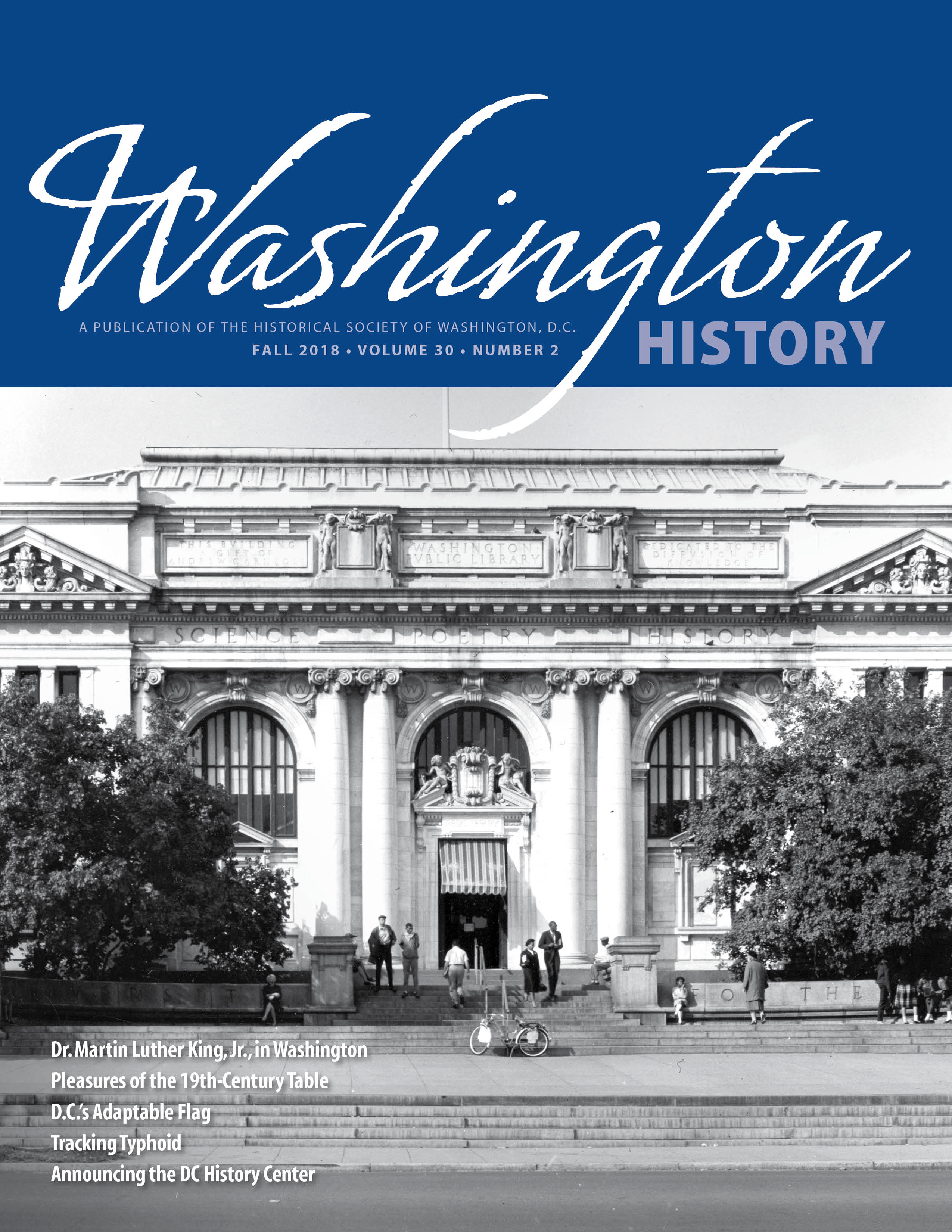
    Washington History magazine

    From 2014 to 2019, the Historical Society of Washington, D.C., published books and magazines about the history of the city. During this time, the organization delivered eight issues of Washington History, the only scholarly publication devoted to the history of our nation’s capital. Started in 1989, it has been printed since 1897. Washington History features scholarly articles, reviews, and an array of images. It is written and edited by historians and journalists.

    Books

    The Spring 2014 issue of Washington History was dedicated to jazz music in Washington, DC. As a result of its success, Georgetown University Press co-published a book about the topic.

    Noted historians Maurice Jackson and Blair Ruble, editors of the magazine and the book, present a collection of original and fascinating stories about the DC jazz scene throughout its history. A co-publishing initiative with Georgetown University Press, the book includes over thirty museum-quality photographs and a guide to resources for learning more about DC jazz.

  • For the Record: The Art of Lily Spandorf

    For the Record: The Art of Lily Spandorf

    This exhibition explores the artwork of Austrian-born watercolorist and journalist Lily Spandorf (1914-2000).

    Working with pen, ink, watercolor, and gouache, Spandorf became known for the news illustrations she created for the Washington Star, Christian Science Monitor, and Washington Post, among many other periodicals.

    For the Record: The Art of Lily Spandorf, George Washington University Museum 2018

    Late in her career, she was celebrated for passionately recording the transformation of Washington, D.C.’s urban landscape, especially the many red-brick, late-nineteenth-century buildings facing demolition, being demolished, or whose historical contexts were erased for modern construction. 

    This exhibition was co-produced by the Historical Society of Washington, D.C., and the George Washington University Museum | The Textile Museum.

  • reVISION::Thinking Big

    reVISION::Thinking Big

    In September 2015, the Historical Society presented “reVISION::THINKING BIG, New Projects in Washington DC,” an exhibit focused on five mixed-use projects currently in design in Washington and in the final stages of development review, or under construction.

    The projects include The Yards, The Wharf, Burnham Place at Union Station, Capitol Crossing, and the McMillan Sand Filtration site. The exhibit examined the theories and context behind each project’s design as well as the complexity inherent in projects of such vision and scope.

    The themes addressed include:

    • Reconnecting to the water
    • Building above barriers, and
    • Re-purposing public works

    Organized by AIA|DC, the exhibit was supplemented by material from the Historical Society’s collections to tell the stories of the past while looking towards the city’s future.